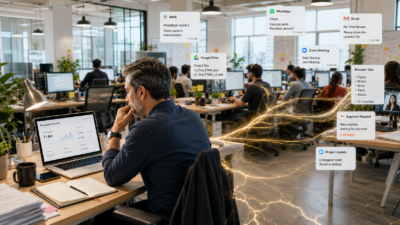
Walk through your studio on any given Tuesday and tell me what you see.
Everyone’s at their desk. Slack is pinging. Calendars are packed. The project board is full of cards sitting in “In Progress.” Heads are down, screens are lit. By every visible measure, you’re running a hard-working, high-functioning team.
And yet, somehow, the campaign is behind. The deliverable due Friday is still “almost ready.” The client is following up again. And you, the person running this studio, are more exhausted than anyone.
How does a team that never stops working still struggle to finish things?
The answer comes down to a distinction that most creative leaders never consciously make: the difference between Active Work and Meta-Work. And once you see it, you can’t unsee it.
Two Kinds of Work, Only One of Which Actually Moves Things Forward
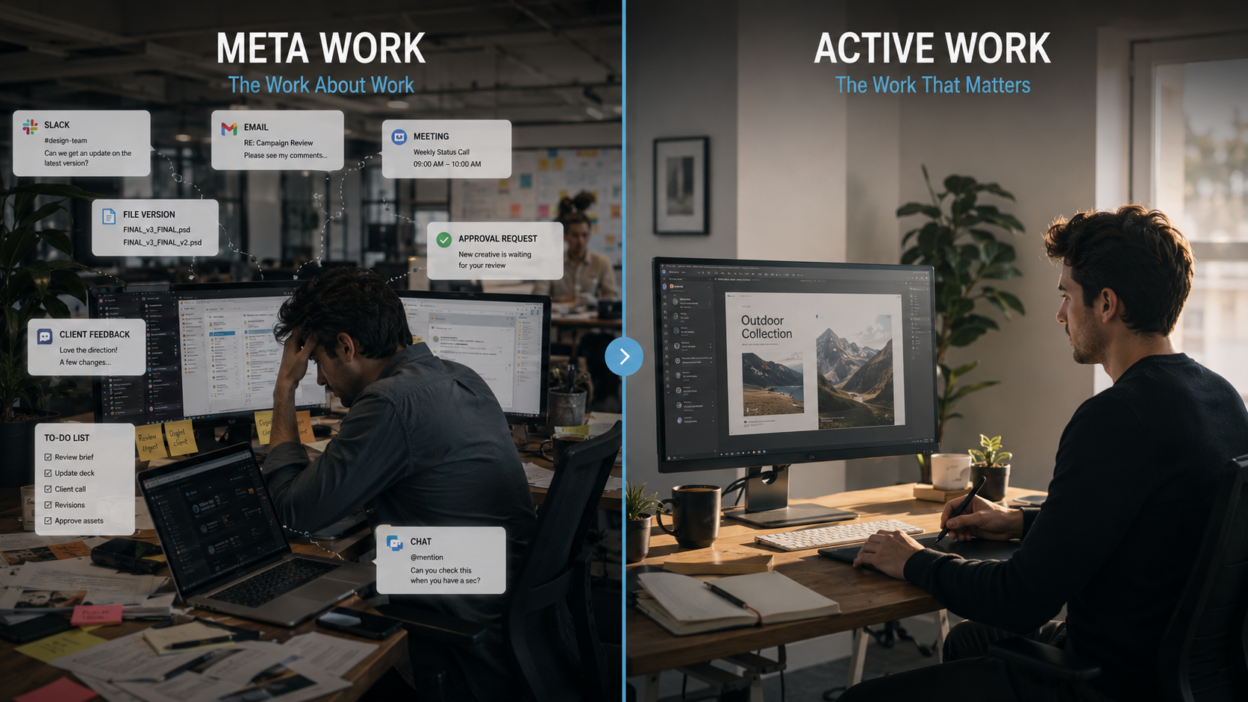
Active Work is the reason your team exists. It’s designing, writing, editing, directing, animating, the skilled craft that clients pay for and that creative professionals were hired to do. It produces something real at the end of it.
Meta-Work is everything that surrounds Active Work without being it. Status updates. Chasing approvals. Searching for the latest file version. Sitting in alignment meetings. Re-explaining a brief that should have been documented. Responding to a Slack thread about a task that already has a Jira ticket. Meta-Work feels productive because it’s busy. It fills the day. It generates motion. But it doesn’t generate output.
The problem isn’t that Meta-Work doesn’t exist, some of it is genuinely necessary. The problem is how much of it has quietly taken over the average creative workday.
Asana’s research across 10,223 knowledge workers found that the average worker spends 60% of their time on “work about work”, the exact category that Meta-Work belongs to, rather than on the skilled tasks they were actually hired to perform. A separate analysis published by SpeakWise in 2026 found that the average knowledge worker achieves just 11.7 hours of genuine deep focus per week, barely 29% of a standard working week. The rest? Meta-Work, in one form or another.
Your team isn’t failing to work hard. They’re working hard at the wrong layer.
Deadlines Are Slipping, The Likely Culprit
When Active Work and Meta-Work live in separate tools and separate conversations, your team pays what we call the Switch Tax every single time they move between them.
A designer is forty minutes into a layout, mental context fully loaded, decisions flowing. A WhatsApp message arrives: “Can you check the client’s latest comment on the brief?” They leave their canvas, open a browser, navigate to the review thread, read the comment, close the tab, and return to the canvas. Elapsed time: two minutes. But the focus, the loaded mental context that took forty minutes to build, is gone. Research cited in our 23-Minute Rule blog shows it takes an average of 23 minutes to fully recover that state.
That single two-minute Meta-Work interruption just cost the team twenty-three minutes of Active Work recovery time. Do that five times in a morning and you haven’t lost ten minutes — you’ve lost nearly two hours of your designer’s best cognitive capacity to a tax they didn’t even know they were paying.
Grammarly’s 2025 Workforce Productivity report found that knowledge workers spend roughly 21% of their workweek on performative or unproductive tasks — work that signals effort without generating output. That’s an entire working day, every week, spent looking busy while Active Work waits.
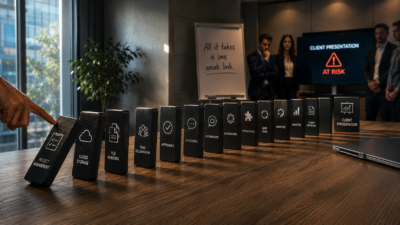
The Switch Tax is how deadlines slip on teams that never stop working.
Three Ways Meta-Work Swallows Active Work in Creative Agencies
The Approval Chase. A piece of work is finished – genuinely done, waiting for a green light. But the approval lives somewhere between a Slack thread and an email and a verbal “looks good” on a call that nobody documented. So the task sits open. The designer pings the account manager. The account manager checks with the client. The client says they already approved it. The account manager relays this back. The designer closes the ticket manually. Three people. Forty minutes. Zero new output. Pure Meta-Work — and it happens dozens of times a month in a busy agency.
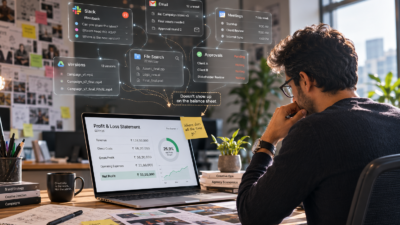
The Version Hunt. The brief has been updated. Or has it? There’s a version in Google Drive, a revised one in an email, and someone mentioned changes on a call last Thursday. Before a single creative decision can be made, the team spends twenty minutes establishing which document is the source of truth. ActivTrak’s State of the Workplace 2025 report found that workers lose significant productive hours weekly just to information fragmentation — searching across tools for context that should be immediately accessible. Every minute spent on the version hunt is a minute not spent on Active Work.
The Alignment Spiral. The standup spawns a follow-up call. The follow-up call reveals a misalignment that requires a separate sync. The sync surfaces a decision that needs sign-off before work can continue. Meanwhile, the creative team is waiting. Microsoft’s Work Trend Index 2025 found that the average person now sits in twice as many meetings as they did just two years ago, with over 60% of professionals saying those meetings actively hamper their output. The irony of the Alignment Spiral is that the more misaligned a team is, the more meetings they schedule — and the more meetings they schedule, the less time they have to do the work that would reduce the misalignment.
How Busyness Culture Makes It Worse
Here’s the uncomfortable part: this pattern doesn’t sustain itself by accident. It gets reinforced, usually by leadership, and usually without anyone realising it.
When a creative director praises the person who responded at 10 PM, the team learns that responsiveness is what gets noticed. When every brief ambiguity triggers a meeting rather than a clear documented decision, the team learns that alignment is always pending. When approval workflows are informal, a thumbs up on Slack, a verbal okay on a call, the team learns that closure is never final.
BambooHR’s survey of over 1,500 full-time workers found that 88% of remote workers feel constant pressure to appear productive. not to be productive, but to look at it. When that’s the culture, Meta-Work thrives. It’s visible, it generates activity, and it signals effort in all the ways that leadership has trained the team to signal it. Active Work (deep, focused, uninterrupted) is invisible by comparison. And invisible work doesn’t get rewarded.
Research from the Center for Creative Leadership found that high-trust teams, measured on outcomes rather than visible effort, achieve 2.5 times better results. The culture shift isn’t complicated to describe: stop rewarding responsiveness, start protecting focus. Stop filling calendars, start defending uninterrupted work time. Measure completion and output, not hours logged and messages sent.
What a High Active Work Ratio Actually Looks Like
Genuinely productive creative teams are often quieter and harder to read from the outside than busy ones. Long stretches of apparent stillness, because the team is in deep focus, which doesn’t look dramatic. Fewer, shorter meetings with clear outcomes. Project boards that move steadily rather than filling up with permanently “In Progress” cards. Deliverables that arrive finished, not almost finished.
PwC’s workforce transformation research found that organisations that prioritise outcomes over activity see 40% higher employee retention and 35% better financial performance. Those aren’t soft benefits, they’re business results that come directly from shifting the ratio of Active Work to Meta-Work in the right direction.
The question for any creative leader isn’t “is my team busy?” It’s “what are they busy with?”
Your team’s Active Work hours are finite and precious. ButtonShift is built to eliminate the Meta-Work that surrounds them, bringing feedback, files, and approvals into the task itself so your team spends less time switching and more time creating. See how it works.
Here’s the question worth sitting with: If you tracked your team’s last full week and separated every hour into Active Work and Meta-Work, what would the ratio actually look like?