Pull up your agency’s tool subscriptions for a moment.
Figma. Slack. Frame.io. Asana. Google Drive. Zoom. Maybe a separate client portal. Maybe a review tool on top of that. Each one has a line on your card statement. Each one, individually, looks reasonable.
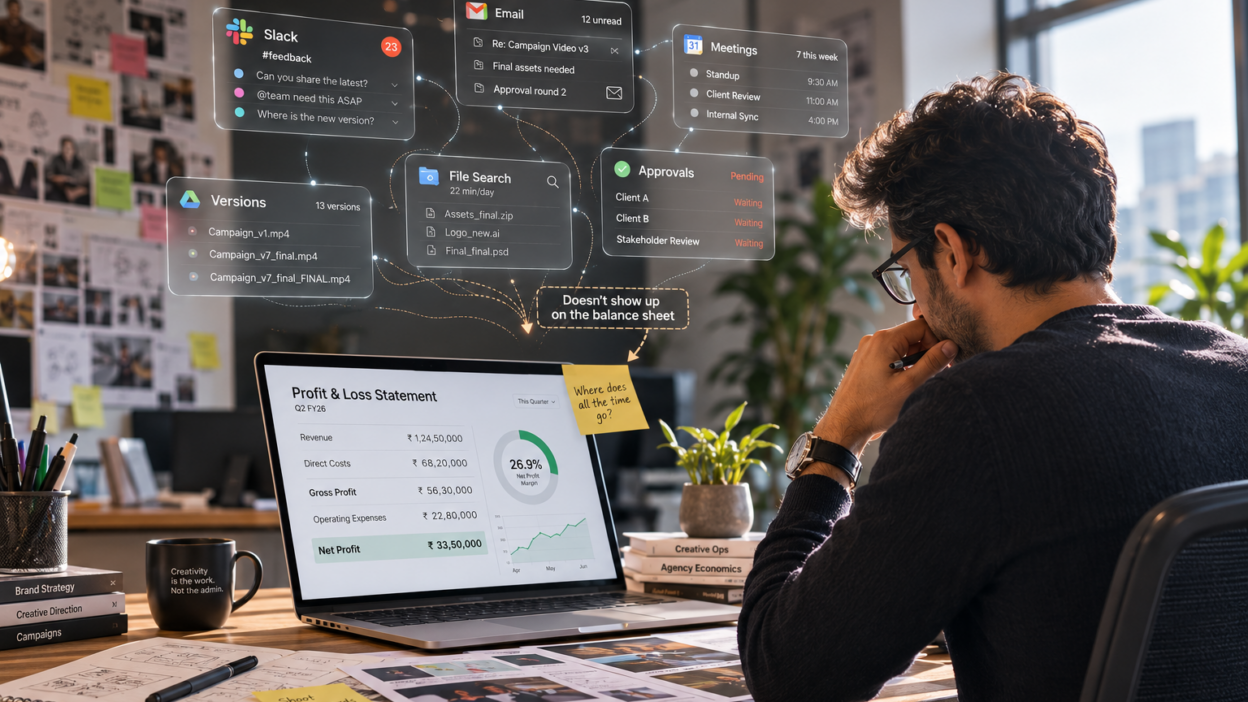
But there is a cost your P&L will never show you. It does not appear on any invoice. No vendor bills you for it. Your accountant cannot see it. And yet, across every creative studio I have spoken to, it is quietly one of the most significant expenses the business carries every single month.
It is the Tool Switch Tax.
What the Tool Switch Tax Actually Is
Every time someone on your team closes one application and opens another, checks Slack, jumps to Frame.io to find a comment, switches to Asana to log a task, reopens the creative file, something happens in the brain that does not happen with a physical object.
Unlike picking up a pen and putting it down, switching between digital tools requires your brain to fully reload context. The mental model you were holding, where you were in the work, what the last decision was, what still needs to happen, it dissolves the moment you leave, and it costs real time to rebuild.
Gloria Mark’s foundational research at UC Irvine put a number on it: after a single interruption, the average worker needs 23 minutes and 15 seconds to fully return to the original task. Not 23 seconds. Twenty-three minutes. And separate research by Speakwiseapp shows employees spend almost four hours per week simply reorienting themselves after switching between applications, which over a full year equals roughly five working weeks lost entirely to the overhead of navigating between tools.
Five weeks. Per person.
Now count the number of people on your team.
It Is Not in the Budget Because It Is Not a Line Item
Here is the reason this cost stays invisible: it does not look like a cost. It looks like work.
When a motion designer finishes a video export, opens Frame.io to check if the client commented, finds nothing, switches to Slack to chase the account manager, gets pulled into a different conversation, remembers the original task, goes back to Frame.io, finds the feedback, opens the edit file, reads the note, realises she needs the original brief to make sense of it, opens Google Drive, searches for the brief, finds two versions, opens both to check which is current, that entire sequence looks like productive work from the outside.
She was at her desk. She was “on” the project. Her timesheet might even say she was working on it.
But the actual creative output during that window? Close to zero.
This is what the Tool Switch Tax looks like in practice. It is not laziness. It is not poor time management. It is the structural friction built into a tool stack that was never designed to work together.
The Math Your P&L Cannot See
Let us put a rough number on it, not to be precise, but to make this real.
Research from workplace technology surveys shows that 69% of workers waste up to an hour every day navigating between communication apps alone. Not all their tools. Just communication apps. That amounts to 32 lost workdays per year, per person.
For a ten-person creative team, that is 320 workdays a year of paid capacity disappearing into the gap between tools.
At an average fully-loaded cost of around $385 per person per day, based on a $100K annual salary plus benefits and overhead, which is a realistic mid-market figure for a creative role in a city like New York or Los Angeles, that translates to roughly $123,000 in annual payroll absorbed by context switching alone for a ten-person team. No deliverable. No output. No billable work. Just the overhead of a fragmented stack.
And that is the conservative estimate. It only accounts for the switching time itself. It does not account for the decisions made on incomplete context, the revisions that happened because feedback lived in three different places, or the scope that crept because a client comment got buried in a Slack thread and was never logged.
The Creative Agency Version of This Problem
In software companies, tool sprawl tends to manifest as developer context switching, moving between a code editor, a ticketing system, a documentation tool, a deployment dashboard. Painful, but relatively contained.
In creative agencies, the problem is worse. Because the work itself is multi-format: video, audio, design files, PDFs, presentations, photography, the tool stack fragments not just by function but by file type. You need one tool to review video, another for design, another for documents, another for audio. And none of them natively connects to your project management system or your messaging layer.
So every time a project moves from one format to another, which in a campaign workflow happens constantly, the team pays a switching tax not just in cognitive load but in platform. A different login. A different link to share with the client. A different place to find the feedback. A different manual step to pull that feedback back into the project tracker.
The work gets done. But the overhead of doing it grows silently with every tool you add.
If you have read our earlier piece on how your profit margin disappears between Slack and Asana, this is the upstream version of that same problem. The gap between tools is not just where context gets lost, it is where time goes to die.
Why “Just Get Better at Using the Tools” Is the Wrong Answer
The instinctive response from a lot of agency operators is process: standardise how the tools are used, create naming conventions, assign someone to keep everything in sync across platforms.
This does not solve the problem. It adds a new job to the problem.
You are now paying someone, or a fraction of everyone, to manage the gap between tools that should not exist in the first place. The sync work itself becomes a new source of switching overhead. The process documentation becomes another thing to maintain. The training required to keep a ten-person team aligned across six platforms becomes a recurring drag on onboarding, handovers, and new client setups.
Research shows that 45% of workers report that toggling between too many apps makes them less productive, while 43% say the constant switching is mentally exhausting. Adding processes on top of fragmented tools does not make people less exhausted. It just gives the exhaustion a better-organised appearance.
The only real fix is to reduce the number of switches. Not manage them better. Reduce them.
What Fewer Switches Actually Looks Like
The goal is not zero tools. That is not realistic, and it is not the point.
The goal is that the work, the file, the feedback, the task that came from it, the conversation about that task, and the approval that closes it, all live in the same place. So that following a project through its lifecycle does not require a person to leave their environment seven times and reconstruct context seven times before they can make a single decision.
When review, tasks, messaging, and approvals share the same workspace, the switch tax drops dramatically. Not because the work is simpler, but because the routing overhead between tools is gone. A comment on a video becomes a task. A task gets assigned and tracked. An approval updates the status. The account manager and the editor both see it in the same place, in real time, without a Slack thread in between.
That is not a workflow description. That is time, real measurable time, returned to the business.
A Question Worth Sitting With
Before your next quarterly review, try this: estimate how many times your team switches tools in a single day of active campaign work. Count the apps, the tabs, the logins, the shared links. Then multiply that by 23 minutes.
The number you get is not in your P&L. But it is absolutely in your margins.
If you could eliminate just one tool switch from your team’s day, which one would it be?
If your team is losing time between tools, ButtonShift brings creative review, task management, messaging, and approvals into one workspace, so the work moves forward instead of the tools. Start your free trial and see how much of that switch tax you can get back.