
It’s launch day, and the campaign is live. The client emails at 9 AM, cheerful, asking for the final performance dashboard. You open it and your stomach drops. The numbers are three days old.
Somewhere between your ad platform, your spreadsheet, and the Slack bot that was supposed to pull everything together automatically, a connection quietly stopped working. Nobody got an alert. Nobody broke anything on purpose. A vendor pushed an update, a field got renamed, an API key expired, and the automation kept “running”, it just stopped doing what everyone assumed it was doing.
This is the moment every growing team eventually meets its Frankenstein Stack: a workflow built from perfectly good parts, stitched together over time, that has quietly become something nobody fully understands anymore.
Nobody Sets Out to Build a Monster
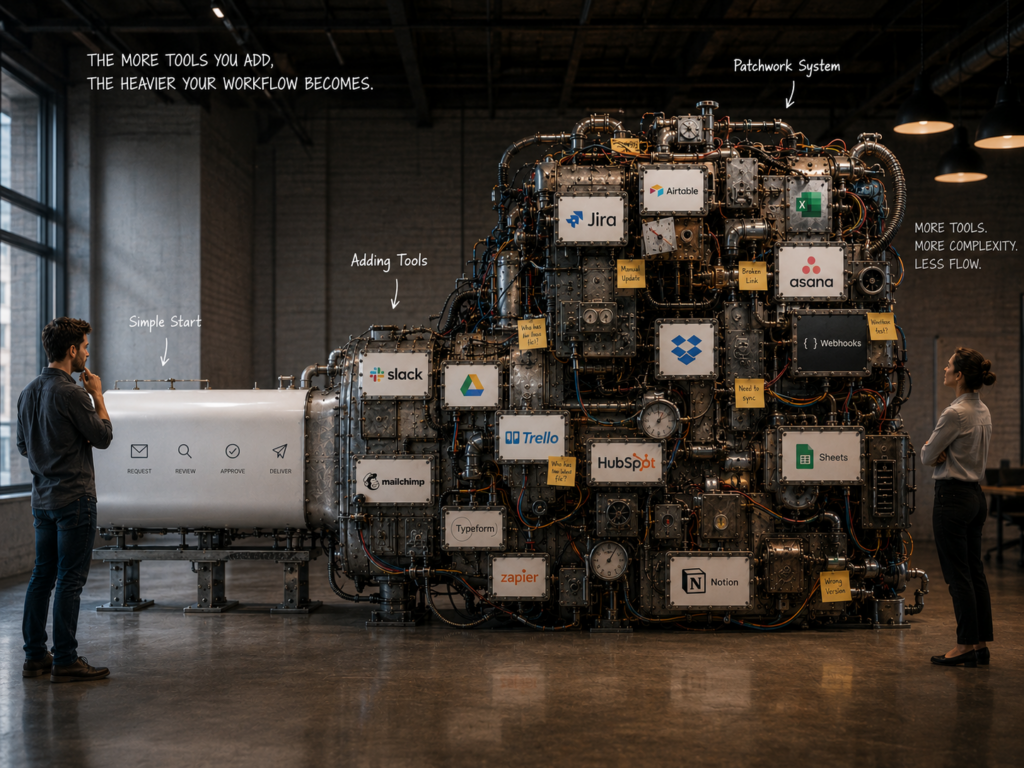
No one wakes up and decides to build an unmanageable tech stack. It happens one reasonable decision at a time.
You start with a project tracker. Then a client asks for faster turnarounds, so you add a Slack integration to ping the team automatically. Then someone on ops sets up a Zapier flow so uploaded files land in the right folder without manual work. Then a freelancer needs access to just one board, so you patch together a workaround because your plan doesn’t support guest seats cleanly. Each addition solves a real, immediate problem. Each one felt like progress.
But stitched together, these individually sensible decisions create something else entirely: a system where the “body” is made of parts that were never designed to move as one. Your task tracker doesn’t know what your storage tool is doing. Your storage tool doesn’t know your feedback tool exists. The only thing holding it all together is a web of small, invisible automations that everyone forgot to document.
This isn’t hypothetical. Research on modern SaaS environments backs up what most teams already sense: the average organisation now carries serious redundancy in its stack, with duplicate project management tools, overlapping collaboration apps, and training platforms nobody remembers signing up for, according to recent workplace technology research. Every one of those overlaps was added for a good reason at the time. That’s exactly how monsters get built, with good intentions, one limb at a time.
Every “Quick Fix” Is Another Stitch
The most dangerous part of a Frankenstein Stack isn’t the number of tools. It’s the connective tissue between them, the integrations, automations, and manual workarounds holding the whole thing together.
When your systems don’t talk to each other natively, someone has to make them talk. So you automate it. A Zap here, a webhook there, a shared spreadsheet that “just needs someone to update it every Friday.” Each of these fixes buys you a few weeks of relief. But none of them are built to last, because none of them were part of an actual plan. They’re patches, applied under deadline pressure, by whoever had access at the time.
Industry researchers have started giving this problem an actual name: workflow debt. Unlike the technical debt engineers talk about, workflow debt lives in your everyday operations, in the approvals, handoffs, and “temporary” workarounds that quietly become permanent. It doesn’t show up in a budget line. It shows up in the fifteen minutes someone loses every morning manually checking whether last night’s automation actually ran.
And when it doesn’t run, when a stitch comes loose, you often don’t find out right away. That’s the nature of duct-taped systems: a recent industry review of workflow automation tools found that automations can fail silently, quietly erasing institutional knowledge and leaving teams to discover the gap only when a client, not a dashboard, points it out first, as several 2026 automation reviews have noted. By the time you notice, the damage isn’t just a missed report. It’s a client wondering if they can trust your process.
The Monster No One Fully Understands

Here’s the part that should worry every team lead: as a Frankenstein Stack grows, ownership disappears with it.
Ask your team who is responsible for the automation that moves files from your shared drive into your project tracker, and you’ll likely get a shrug. Someone set it up eighteen months ago. They may not even work there anymore. Nobody wants to touch it because nobody’s sure what else it’s connected to. So it stays exactly as it is, quietly aging, quietly becoming more fragile, one vendor update away from breaking in a way nobody can trace.
This is precisely what recent enterprise integration research is flagging as a growing operational risk. A 2026 connectivity benchmark found that the vast majority of IT leaders now report real integration challenges, and most agree that automation only reduces complexity when it’s built on integrations that are actively maintained, not left untouched since the day they were switched on. Without that upkeep, automation doesn’t remove work. It just hides it, until the day it resurfaces as a client-facing problem.
For creative and production teams especially, this is a costly blind spot. You’re not running a software company with a dedicated integrations team auditing every connection. You’re running campaigns, shipping edits, and managing client relationships. Nobody has the bandwidth to be the stack’s full-time surgeon.
Not Sure How Many Stitches Are Holding Your Workflow Together?
Most teams don’t, until something breaks in front of a client.
See how ButtonShift replaces the patchwork
Signs You’re Already Living With One
A Frankenstein Stack rarely announces itself. It just starts showing up in small, familiar ways:
- A task’s status on your tracker doesn’t match what actually happened to the file.
- Two people update the “same” spreadsheet, and one version quietly overwrites the other.
- New hires need a whole onboarding session just to learn which of your six tools is the “real” source of truth.
- Someone says, “let me just check if that automation actually ran,” at least once a week.
- The person who built a key integration has left, and everyone’s a little afraid to touch it.
None of these, on their own, feel like a crisis. That’s exactly the problem. A Frankenstein Stack doesn’t fail loudly. It fails quietly, in small increments, until the day a client, not your team, is the one who notices something’s wrong.
Amputation Isn’t the Answer. Design Is.
The instinctive response to a Frankenstein Stack is to start ripping tools out. But that’s rarely the real fix, because the tools were never really the problem. The absence of a plan was.
A workflow built on native structure, where tasks, files, feedback, and status live inside one connected system by design, doesn’t need the same volume of stitching. There’s simply less to hold together, because the parts were built to move as a single body in the first place. That’s a fundamentally different proposition from “fewer apps.” It’s about reducing the number of invisible joints your work has to pass through to get from a brief to a finished, approved deliverable.
This doesn’t mean your specialists give up their craft tools. Editors still edit where they edit best, designers still design where they design best. What changes is what happens around that work, whether tracking, feedback, and handoffs require a fragile web of automations to function, or whether they’re simply part of how the system already works.
The Bottom Line
Your workflow probably didn’t get complicated on purpose. It got complicated the same way every Frankenstein Stack does: one useful integration, one quick automation, one workaround at a time, each one reasonable in isolation.
The question worth asking isn’t “how many tools do we have?” It’s “how many of our tools are actually talking to each other, and how many are being held together by something nobody remembers building?”
Before your next deadline exposes the gap, take an afternoon and trace one workflow, start to finish. Follow a single deliverable from brief to client approval, and count every handoff, every automation, and every person who has to manually check that something “actually happened.” If that number surprises you, you’ve found your stitches.
How many invisible automations are quietly holding your workflow together right now, and do you know what happens if one of them fails tonight?
Stop Patching. Start Building.
If your team is tired of discovering broken stitches the hard way, let’s talk about what a genuinely unified workflow looks like for creative teams.