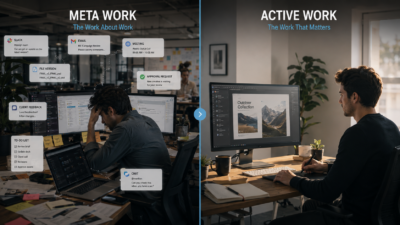
There’s a version of your day that looks productive from the outside.
You’re in your inbox. You’re on a call. You’re chasing an approval, forwarding a brief, re-explaining a revision, updating a task status in one tool because the comment came in through another. You’re busy. Genuinely, unmistakably busy.
And yet, by the end of it, you haven’t made anything.
This is the work between work. The coordination layer that sits between every creative output and the person trying to produce it. It doesn’t show up in portfolios. It doesn’t get presented in client reviews. But it is, for most creative teams, where the day quietly disappears.
The Output Problem
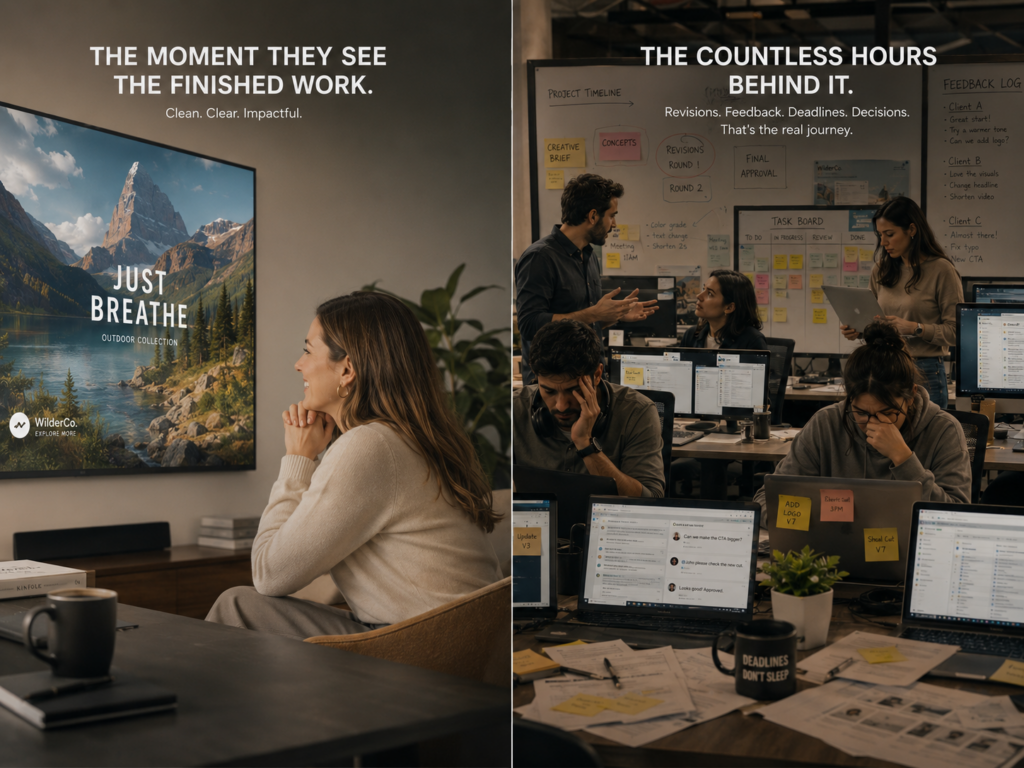
Here’s the uncomfortable truth about how creative teams are measured: by what they produce.
The video that shipped. The campaign that launched. The deck that got approved. These are the things that matter to clients, to leadership, to the people writing the invoices. And rightly so, they are, after all, what you were hired to make.
But the people doing the measuring rarely see what surrounds that output. A senior designer working at 50% utilisation means half their paid time is spent on non-billable tasks, meetings, status chasing, re-briefing, tool-switching, and the thousand small acts of coordination that keep a project moving without actually moving it forward.
Nobody’s grading the team on how efficiently they handled feedback handoffs. Nobody’s scoring the project manager on how many threads they had to dig through to find the one approval that unblocked the edit. The overhead is invisible in the assessment, even when it’s consuming half the working day.
What the Coordination Tax Actually Looks Like
Researchers have been circling this problem for years. Cal Newport calls it the “overhead tax”, the ongoing administrative burden that activates the moment you take on a new commitment: back-and-forth threads to gather information, meetings scheduled to synchronise with collaborators. The more people on a project, the more this tax compounds.
For creative teams specifically, it tends to show up in a handful of very recognisable patterns.
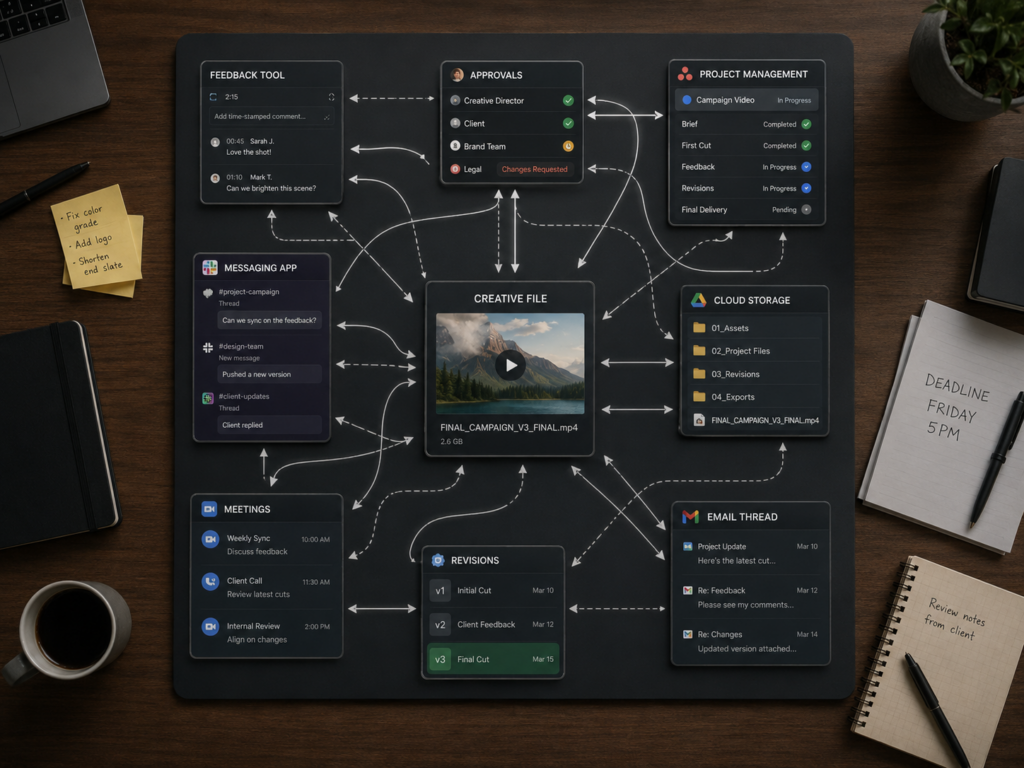
The re-explanation loop. A client leaves feedback on a video. The feedback lives in one tool. The task lives in another. Someone has to manually bridge that gap, copy the comment, re-word it as a task, assign it, and then hope the editor picks it up before the revision window closes. Information that should flow directly gets filtered through a human relay instead.
The approval black hole. You send something for a sign-off. You wait. You follow up. You follow up again. You check email. You check WhatsApp. You check the review tool. You send the same asset three different ways because you’re not sure which channel your client actually checks. The work is done. The approval is the work now.
The status meeting that exists because nobody knows the status. A Monday standup exists to answer three questions: what was delivered last week, what is being worked on this week, and what is blocking progress. That meeting exists entirely because the answers to those questions aren’t visible anywhere else. If they were, the meeting wouldn’t need to happen.
The tool handoff. Your feedback comes in through a review platform. Your tasks live in a project management app. Your conversations happen on a messaging tool. Your files are in cloud storage. Your approvals are tracked on a spreadsheet someone built two years ago and nobody wants to touch. Each switch between tools carries a cognitive cost that accumulates across the day into something that feels a lot like exhaustion, even when the actual creative work was energising.
Why Nobody Names It
Part of the reason this overhead stays invisible is that it’s distributed. No single task feels like much. Forwarding an email takes thirty seconds. Updating a status takes a minute. Re-explaining a brief to a new team member takes ten. None of it feels like the problem.
But Cubitrek’s 2025 global research found that only 28% of a marketer’s time is actually spent on their core work, with up to 30% of capacity consumed by coordination overhead alone. Creative agencies aren’t immune to that number. Most are closer to it than they’d like to admit.
The other reason it stays hidden is more uncomfortable: creative teams are often reluctant to name it, because naming it sounds like complaining. It sounds like you’re saying the work is too hard, or the clients are too demanding, or the team isn’t good enough. None of that is true. The problem isn’t the people. It’s the architecture, the way tools, processes, and communication channels are set up to treat coordination as an afterthought rather than a cost.
We wrote about this from a different angle in our piece on the hidden bottlenecks in your creative process, specifically, how scattered feedback across five platforms doesn’t just slow things down, it erodes the clarity that creative teams need to do their best work. The coordination overhead and the feedback chaos are the same problem wearing different clothes.
The Real Question Underneath All of This
If you stripped away every re-explanation, every status chase, every approval ping, every tool switch, how much more would your team actually make?
It’s worth sitting with that question honestly. Not as an indictment of anything you’re currently doing, but as a genuine measure of what the coordination tax is costing you. When effort is invisible, overcommitment becomes the norm. Teams end up stretched thin, stuck in endless revision cycles, or working late to make up for timelines that were scoped around the creative work, not the coordination surrounding it.
The designers aren’t slow. The editors aren’t disorganised. The project manager isn’t dropping the ball. They’re spending a meaningful portion of their day doing work that exists only because the systems around them weren’t built to make it unnecessary.
That’s the work between work. And the first step to addressing it is simply agreeing that it exists, that it has a cost, that the cost is real, and that it belongs in any honest conversation about how creative teams operate.
A Different Way to Think About It
The teams that seem to run smoothly, the ones where projects flow from brief to delivery without too much drama, aren’t necessarily more talented or better resourced. They’ve usually just reduced the distance between the moment feedback is given and the moment work begins. Between the moment a decision is made and the moment everyone who needs to know, knows.
That’s the design principle behind ButtonShift, keeping feedback, tasks, approvals, and communication in the same place, so the coordination layer doesn’t quietly become a second job. When the gap between review and execution moves closer, the work between work shrinks with it.
But regardless of what tools you use, the underlying shift matters more than any specific solution: start treating coordination overhead as a real cost, not background noise. Measure it. Talk about it. Design against it.
Your team is being judged on what they make. They deserve a system that makes it easier.
How much of your team’s day do you think is spent on coordination versus actual creative work, and have you ever tried to measure it? We’d genuinely like to know.