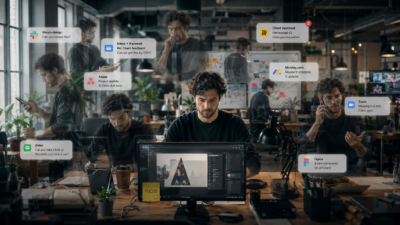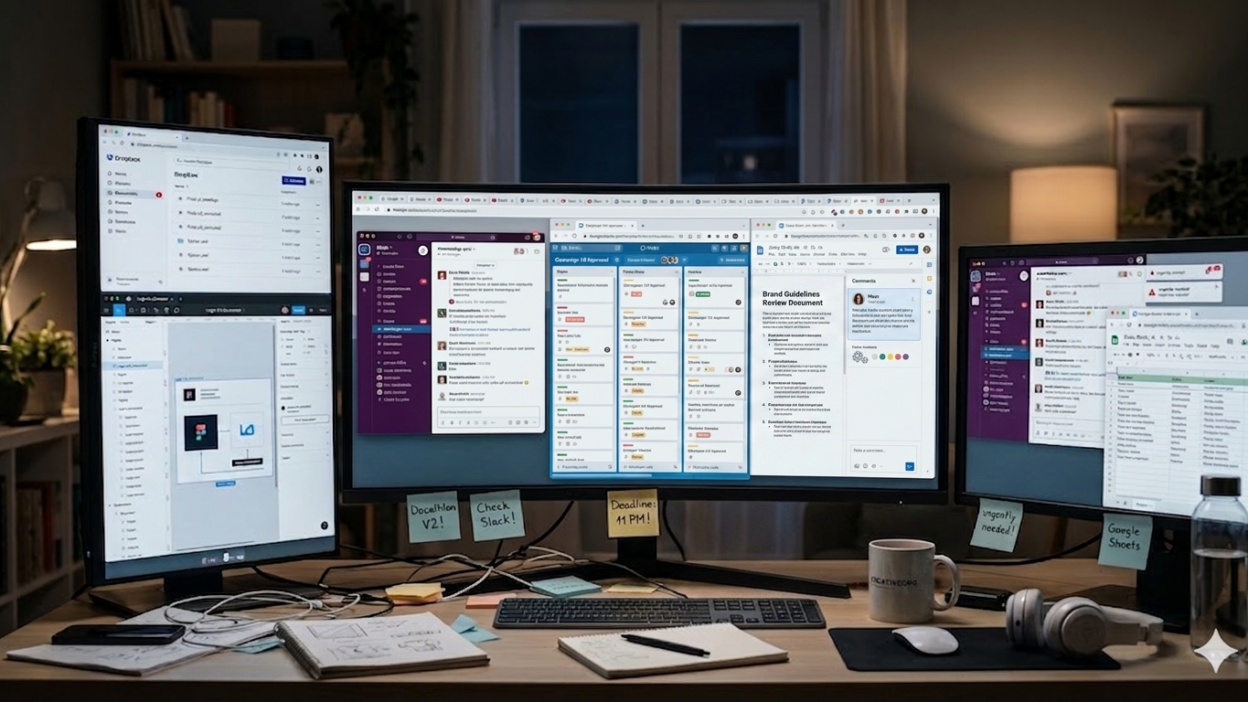
It’s 11:00 PM on the night before the big launch.
You have 14 tabs open. Your heart rate spikes because you realize you sent the client the wrong hero video. Instead of “Final_v2_Corrected” from Slack, you sent “Final_v1” from Dropbox. You scramble through a Trello board to find the caption approved three days ago, only to discover the copywriter saved the link in a Google Doc you can’t access.
It’s a digital scavenger hunt.
We’ve been sold the dream of the “Best-in-Class” tech stack, but for most creative teams, that stack has become a prison of Context Switching. We’re spending 60% of our day just moving information between apps, leaving only the scraps of our energy for the Deep Work that actually makes a campaign successful.
It leads to the question every agency founder and creative lead has asked themselves: How many tools does it take to ship a single campaign?
The short answer? It’s not about the tools. The long answer? It’s about the cost of the gaps between them.
Intent: Where Smooth Execution Actually Starts
Before we talk about software, we have to talk about intent.
Smooth execution isn’t a byproduct of buying a more expensive subscription; it is the result of how you deconstruct a campaign. A campaign isn’t a “monolith.” It is a living machine made of moving parts: Social, Ads, PR, Influencer, and Creative.
When execution fails, it’s rarely because the designer didn’t know how to use Figma or the copywriter forgot how to use Google Docs. It fails because the Intent (the “what” and the “why”) gets fractured when it moves through the Departments (the “who”).
To ship effectively, you have to break down the campaign into its deliverable components first. You need to know exactly what is being birthed in Social, what is being optimized for Ads, and what the core Creative anchor looks like. But once you have that roadmap, a new problem emerges: The Fragmented Stack.
The “Ideal” Stack (And Why It’s a Lie)
In a vacuum, every department has its “Primary Tool,” the place where the actual work happens. It’s their sanctuary.
- Copywriting lives in Google Docs or Notion.
- Statics & UI live in Figma.
- Video Editing lives in DaVinci Resolve or Premiere Pro.
This makes sense. You want your specialists using the best instruments for their craft. However, the work doesn’t stay in these tools. It has to move. It has to be tracked. It has to be talked about.
This is where the “Tool Sprawl” begins. Suddenly, to ship one campaign, you need:
- A tool to track all deliverables (The Project Manager).
- A tool for seamless communication (The Messenger).
- A tool to store all assets (The Storage).
- A tool to manage feedback and iterations (The Reviewer).
On paper, this sounds organized. In reality, you’ve just created four different “sources of truth,” making Context Switching a mandatory part of the job description.
The Context Switch Scenario
Imagine you are a creative lead. You’re deep in the “flow state,” reviewing a high-stakes video edit, the exact moment when Deep Work is supposed to yield results.
You receive a Slack message with feedback.You open the Slack thread, but the feedback refers to a specific timecode. You open the video file in Google Drive to find that timecode. But wait, the designer says they updated the file, and that version is in the “Drafts” folder, not the “Main” folder. Now you have to check your Project Management tool to see which task this actually belongs to so you can mark it as “Revised.”
In this scenario, you haven’t done any creative work. You’ve just been a Digital Switchboard Operator.
As we’ve explored in our breakdown of The 23-Minute Rule, a single interruption or a quick “hop” between tabs triggers a cycle of Context Switching that can take nearly half an hour to recover from. When your “Tracking,” “Communication,” “Storage,” and “Feedback” live in four different tabs, your team isn’t working; they are constantly rebooting their mental operating systems. This is the “Chaos Tax,” and it is the primary reason campaigns ship late, over budget, and with avoidable errors.
The Impact: High Attrition and “Shallow” Work
When you fragment your work across too many tools, the impact isn’t just a loss of minutes. It’s a loss of depth. According to the American Psychological Association, even brief mental blocks created by shifting between tasks can cost as much as 40 percent of someone’s productive time.
If a creator spends 30% of their day navigating between tools just to find a comment or a link, they only have 70% of their cognitive energy left for the breakthrough idea. The environment becomes hostile to deep work. Over time, this breeds a culture of “Shallow Work,” where the goal is just to “get it done” rather than “get it right.”
For the agency, this leads to the most expensive problem of all: Attrition. High-end creative talent doesn’t quit because the work is hard; they quit because the process is exhausting. They want to protect their deep work hours, not act as a librarian for their own files. Experts at Forbes have noted that constant Context Switching is one of the hidden challenges behind the modern multitasking myth, and it’s the quickest way to burn out your best minds.
The Solution: The Two-Tool Philosophy
What if the answer isn’t “more tools,” but a radical simplification?
We believe the most efficient agencies in the next decade won’t be the ones with the flashiest tech stacks. They will be the ones that operate with only two primary pillars:
- The Primary Tool of Work: Where the creation happens (Figma, DaVinci, etc.).
- The Unified OS: Where everything else happens.
Imagine a single source of truth where your Tasks are linked directly to your Assets. Where your Communication happens on the file itself, not in a separate chat app. By minimizing the stack to a Unified OS, you eliminate the “Fracture” and significantly reduce the frequency of Context Switching.
The designer doesn’t have to leave the video to see the feedback. The founder doesn’t have to ask “where are we on this?” because the status of the work is a byproduct of the work itself. This architecture is designed specifically to keep the team in a state of deep work for as long as possible.
From “How Many” to “How Many SHOULD It Take?”
When we ask “How many tools does it take to ship a campaign?”, we are usually looking for a list of apps to buy. But that’s the wrong question.
The real question we should be asking is: “How many tools SHOULD it take to ship without losing our minds?”
If your infrastructure requires your team to be “Digital Scavengers” just to find a final render, no amount of talent will save your margins. You don’t need a bigger team. You need a single source of truth—a place where work, conversations, and tracking live together. When everything is in one system, context switching becomes the exception, not the rule.
When you reclaim your time from the gaps between tools, you finally make space for the deep work that defines your agency’s value. Because at the end of the day, a tool should be a bridge to the finish line, not a hurdle in the way.
Does your current workflow feel like a bridge, or a maze?