
If you run a creative agency, you’ve likely felt a specific kind of tension during your Friday afternoon wrap-ups.
The team worked late. The Slack channels were buzzing. Every seat was occupied by a high-level talent you spent months recruiting. Yet, looking at the billables and the project milestones, the math doesn’t add up.
A project that should have been a “quick win” somehow bled into three extra days. A creative lead who usually thrives is starting to look frayed at the edges. When you try to find the culprit, the usual suspects appear:
- “The client was too vague.”
- “We’re drowning in internal meetings.”
- “The creative process just takes time.”
You are partially right. These are the visible symptoms. But if you try to treat them directly, by policing the “ambiguity” or slashing your meeting invites, you’re likely to find that the leak doesn’t stop. It just moves elsewhere.
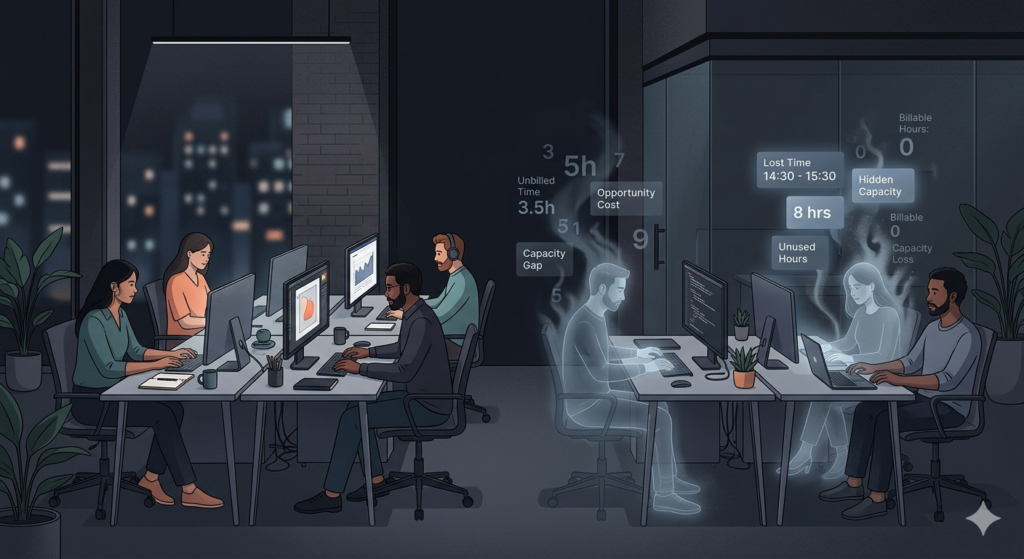
That’s because the true root cause isn’t a lack of effort; it’s a structural drain on your agency’s cognitive capital, slowly starving the creative Deep Work that actually drives your margins. We call it Ghost Capacity.
The Symptom: “Our Creatives Are Getting Slower”
One of the most common complaints we hear from agency owners is that their execution speed is dropping despite adding more tools to the “stack.”
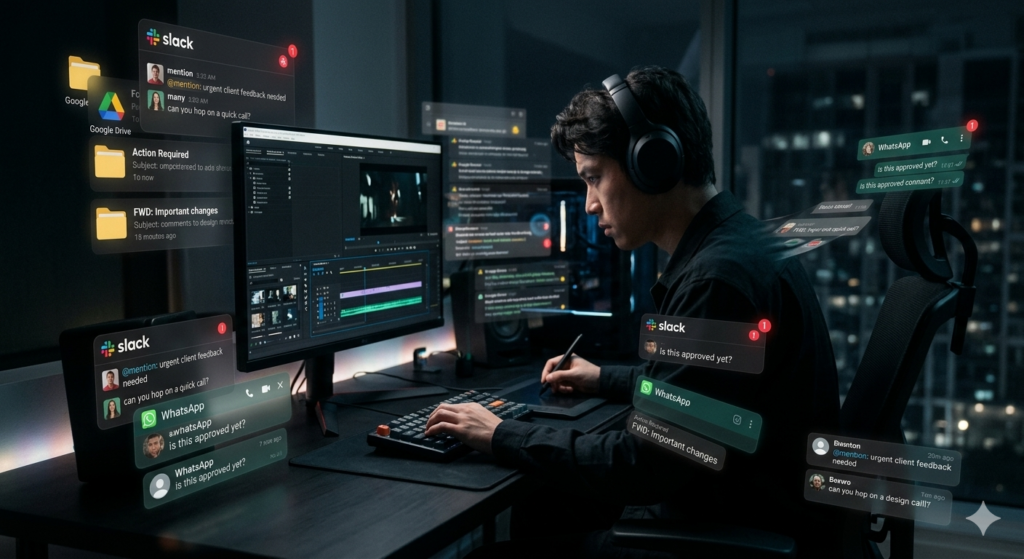
When a designer takes four hours to implement a “simple” round of feedback, the gut reaction is to question their productivity. But in a modern agency environment, that designer isn’t just designing. They are performing a digital commute.
They are jumping from the design file to the feedback thread, then to the asset library to find a missing logo, then to a project management tool to update a status, then back to the design file to remember where they left off.
This is the Switch Tax in action – the direct financial penalty of constant Context Switching. While we’ve previously explored the science of The 23-Minute Rule, the business reality is simpler: you are paying for “reboot time.”
According to research highlighted by the American Psychological Association, even the smallest mental blocks created by shifting tasks, otherwise known as Context Switching. can cost up to 40% of someone’s productive time. In an agency, that 40% of lost focus is a direct hit to your team’s capacity for Deep Work, and ultimately, your profit margin.
Why “Fixing the Brief” Won’t Fix the Leak
It is a common myth that if we just had “perfect briefs,” the agency would scale. But ambiguity is a feature of the creative industry, not a bug. Clients hire agencies precisely because they don’t know exactly what they want yet. To resolve that ambiguity, however, your team needs uninterrupted blocks of Deep Work.
The problem isn’t the ambiguity itself; it’s how your agency’s infrastructure handles it.
When information is scattered across a fragmented tool stack, Context Switching becomes a multiplier for chaos. If a client’s “vague feedback” is sitting in an email, but the work is happening in a specialized design tool, and the “coordination” is happening in a third-party chat app, your team spends 60% of their day just trying to build a “Source of Truth” in their heads.
The Economic Times recently discussed how the “ASAP culture” creates a cycle of constant interruption. For an agency, this means your most expensive assets, your creative brains, are being used as data-entry clerks, moving information from one tab to another.
The Meeting Trap: A Coordination Failure
We often blame “too many meetings” for a lack of work getting done. But meetings are often just a desperate attempt to fix Coordination Gaps that the software should have handled.
When a team isn’t well-coordinated, they use meetings as a “syncing” mechanism because their tools don’t talk to each other. If your project management tool doesn’t actually contain the work, and your work tool doesn’t contain the feedback, you must have a meeting to bridge the gap.
This creates a “Meeting-Work-Meeting” sandwich. The creative member has 45 minutes of “free time” between calls. Knowing they can’t reach a Flow State in that window, they avoid starting any high-value Deep Work and instead stick to “Shallow Work” checking emails, updating tickets, and performing administrative tasks.
This high-frequency Context Switching means you are paying for a Senior Creative Director, but for three hours a day, you are getting a Junior Administrator. That is where your revenue is leaking.
The Myth of the “Best-in-Class” Stack
We’ve been told that a specialized tool for every department is the mark of a sophisticated agency. But as we’ve discussed in our look at Agency Tool Sprawl, more tools usually equal more “Fracture Points.”
Every time an asset moves from one platform to another, there is a risk of data loss, a lapse in context, and a mandatory “Switch Tax” driven by constant Context Switching.
Scaling an agency shouldn’t feel like adding more weight to a backpack. It should feel like removing the friction from the wheels to give your designers and editors the quiet environment they need for Deep Work.
To stop the leak, you have to move past the “symptoms” and look at the architecture. You can’t stop clients from being ambiguous, and you can’t stop your team from needing to communicate. But you can collapse the distance between where the work is discussed and where the work is done.
The Root Cause: Reclaiming Ghost Capacity
The agencies that will thrive in the next few years aren’t the ones with the flashiest portfolios; they are the ones with the tightest operations.
They understand that Ghost Capacity is their biggest competitor. They know that every time a designer has to ask “Where is the latest version of this?” or a project manager has to “nudge” someone for a status update, a dollar is falling out of the agency’s pocket.
Plugging this leak requires a shift in philosophy:
- Acknowledge the Reboot Time: Stop measuring productivity by “hours worked” and start measuring it by “uninterrupted blocks of Deep Work.”
- Consolidate the Context: If the feedback isn’t attached to the task, the task isn’t ready. Keeping them unified cuts down on Context Switching at the critical hand-off points.
- Audit the “Digital Commute”: Watch a team member ship one deliverable. Count how many tabs they have to open. Each tab is a potential revenue leak.
The Bottom Line
Your agency isn’t “slow” because your team is uninspired. Your agency is “slow” because it is fighting its own infrastructure.
When you collapse the “coordination gap” and eliminate the need for constant context-switching, the “symptoms” – the endless meetings, the slow execution, the coordination friction simply evaporate, making space for consistent Deep Work.
You don’t need more people to scale. You just need to give the people you have their focus back.
Are you ready to stop paying the Chaos Tax? Don’t let Ghost Capacity erode your margins. Discover how a Unified Creative OS can turn your agency’s fragmented workflow into a high-speed production engine. Stop the Leak Here.
Find The Hidden Revenue Leak In Your Creative Workflow
Most teams don’t notice the leak until they calculate it.