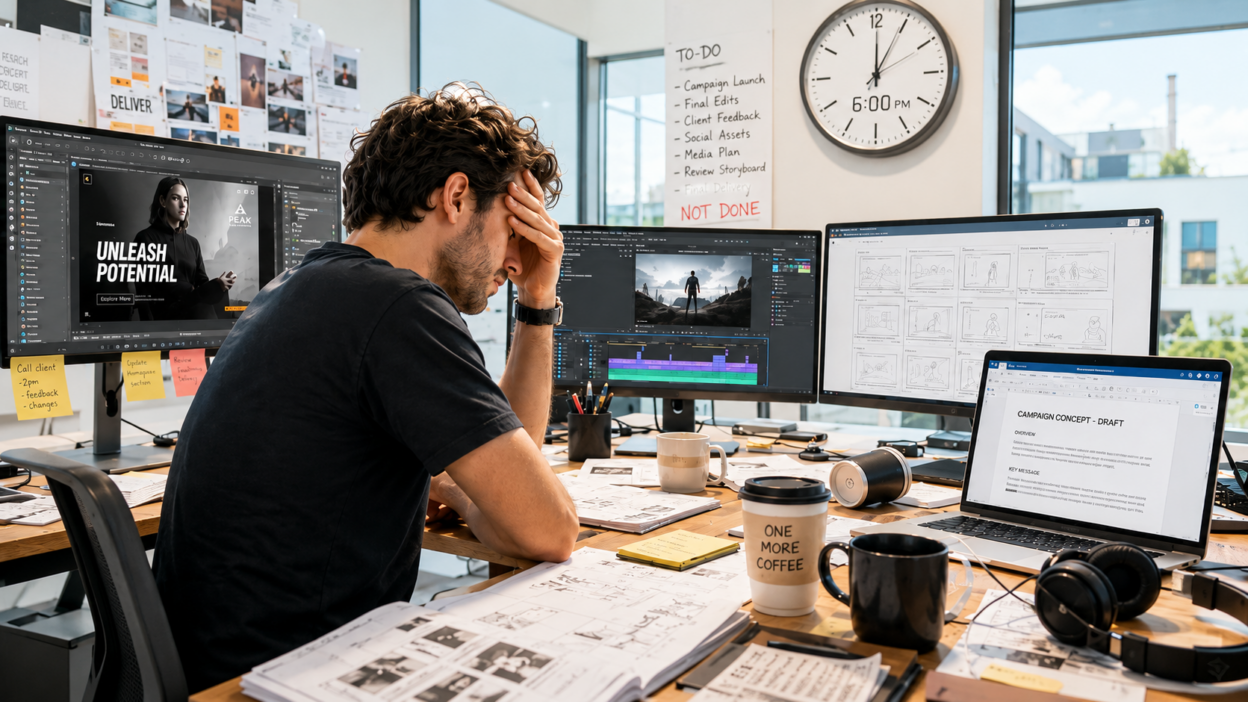
It is 6:00 PM on a Thursday. You sit back in your chair, stare at your screen, and close your laptop.
Your eyes are dry, your head is buzzing, and you feel completely depleted. You have spent nine hours typing, clicking, and thinking. By all accounts, you have worked incredibly hard.
But then you look at your output for the day.
The campaign layout isn’t finished. The script edit is still a half-formed draft. The storyboard revision is only two frames longer than it was this morning. You didn’t actually cross a single project off your list.
You are left with a hollow, frustrating feeling of empty-handed exhaustion.
How can you be this tired and yet have so little to show for it?
You worked the entire day. But the truth is, you didn’t actually spend eight hours designing, writing, or editing.
You spent eight hours getting ready to design, write, or edit.
Every time you were pulled away from your canvas to answer a ping, hunt down a shared drive link, or double-check client feedback, your mental workspace was wiped clean. The true waste of creative capacity inside modern teams isn’t the time they spend away from their desks; it’s the massive “reboot tax” they pay to rebuild their mental workspace every single time they return to the craft.
The Metaphor of the Mental Sandcastle
Creative work isn’t just physical execution. When you are designing a brand identity, cutting a film, or writing copy, you are simultaneously holding a fragile architecture of rules, visual parameters, and narrative goals in your head, the brand’s tone, the typographic limits, where the transition lands against the voiceover, which audience pain point this paragraph is addressing.
Constructing this mental model is like building a delicate sandcastle of thoughts.
It takes fifteen to twenty minutes of uninterrupted concentration to carry the sand, shape the walls, and balance the towers in your working memory. Only when the sandcastle is fully built can you make meaningful creative decisions.
But then a notification chimes.
A Slack message: “Hey, do you know where the latest vector logo is stored?” An email: “Client has added a comment in the review portal.”
Ten seconds to read it. It feels harmless. But that tiny interruption is a giant foot that kicks your mental sandcastle flat.
When you return to your canvas, you can’t resume where you left off. You have to spend another fifteen minutes rebuilding the entire sandcastle from scratch, just to remember what you were trying to do.
Five interruptions in a morning isn’t fifty seconds of lost work. It’s over an hour and a half spent rebuilding sandcastles you’d already built.
The Physics of the “Mental Boot Cycle”
Think of it like a computer. RAM is fast, temporary, active. The hard drive is slow, deep storage.
When you’re in creative flow, your mental RAM is fully loaded with all the context of your project. When a distraction hits, your brain clears its RAM to process the new input, and dumps your work back into deep storage.
Returning to your canvas means running a full mental boot cycle. Your brain has to fetch the mood board, the typeface rules, the client’s notes from long-term memory and slowly reload them. That’s why returning to work feels physically heavy. Why do you stare blankly at your screen before your hands start moving again.
Fifteen context switches a day means fifteen complete cold restarts. By 3:00 PM, your mental battery is drained, not from creating too much, but from spending all your energy rebooting. This is where workspace clutter turns directly into creative burnout.
Why We Are Stuck in the “Reboot Loop”
We don’t live in this state because we want to. We’re trapped here because the context we need to do our work is scattered across a fragmented landscape, Slack threads, email chains, project boards, shared drives.
Imagine you’re deep in a design canvas. You need to verify if the client wanted “dark slate blue” or “midnight blue” on the secondary header. To answer that single question, you have to leave your creative software, jump into your browser, search through a client feedback thread, find the note, and jump back.
Less than a minute. But you’ve left your creative environment, kicked over your sandcastle, cleared your RAM, and now you’re paying the full reboot tax just to get back to work you were already doing.
The Human Cost: The “Invisible Hustle”
When a writer or designer goes home after a day of constant mental restarts, they don’t feel accomplished. They feel guilt. They look at their blank page or half-finished timeline and think: Why am I working so hard but getting so little done? Am I losing my edge?
This is the “Invisible Hustle”, the exhausting, unrecorded work of constantly logging back into your focus.
Your team isn’t burning out because the briefs are too hard or the creative bar is too high. Creatives love a tough challenge. They burn out from the cognitive exhaustion of restarting their brains fifteen times a day.
Eventually, that fatigue erodes the joy of the craft itself. The work stops feeling like creation and starts feeling like an endless administrative chore.
What We Can’t Change, What We Can
When agency owners and creative directors notice this fatigue, their instinct is to process their way out of it. More checklists. Stricter guidelines. Another alignment meeting.
But you cannot process your way out of a broken environment.
Some things are fixed: clients will send feedback, revisions are a natural part of collaborative work. Teams will need to align. These are the structural realities of agency life.
But while you can’t stop feedback from coming, you can change how it’s delivered. The problem isn’t that client notes exist, it’s that your tools force your team on a digital scavenger hunt across three different apps just to find them.
The Solution: Designing a Zero-Reboot Workspace
The fix is a workspace where context lives natively inside the task itself.
This is what we call Slam-Shut Focus, a state where every piece of information a creator needs lives inside their active workspace, so they never have to leave the canvas to find it.
Here’s what that looks like in practice:
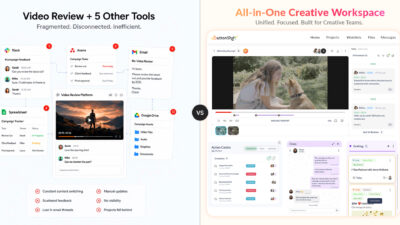
The Old, Broken Way: An editor gets a Slack message about client feedback. They open email, click a link to a separate review tool, find the comment at 0:14 (“Replace this background music with the jazzy track”), open Drive to find the file, download it, import it to Premiere, then manually update the project tracker. The sandcastle has been knocked over four times before the edit even begins.
The Slam-Shut Way: The editor opens the active edit in their unified workspace. At 0:14 on the timeline, the client’s comment is pinned, with the “jazzy track” file attached directly to it. They make the change, hit upload, and the status automatically shifts to “Awaiting Sign-off.” They never left the window. They hardly paid any reboot tax.
When context lives inside the task, the digital commute drops to zero. Your team stops spending half their day rebuilding sandcastles, and can finally spend their energy building them higher.
Reclaiming Your Team’s Cognitive Space
Protecting focus isn’t about stricter guidelines or better time management. It’s about cleaning up the digital environment your team inhabits every day. When you collapse the distance between communication and creation, you stop the cycle of constant mental restarts.
ButtonShift was built to do exactly this, bringing files, feedback, and tasks into a single creative home so your team can stay in flow.
Discover how ButtonShift unifies your files, feedback, and tasks into a single creative home.
The next time you close your laptop feeling utterly exhausted but with a frustratingly short list of completed work, ask yourself an honest question: How many times did you actually work on your creative craft today, and how many times were you just rebuilding the sandcastle?