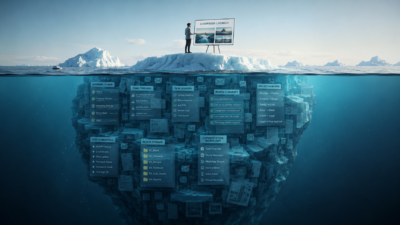
It’s Sunday evening. The weekend has been decent. You’ve rested, spent time away from the screen, done the things that are supposed to recharge you.
And yet, there it is. A low, quiet dread sitting somewhere behind your sternum. Tomorrow is a full week. Briefs to review, revisions to push through, a client presentation to finish. You know you’re good at this. You know you chose this. So why does your chest feel slightly heavy at the thought of Monday morning?
If you work in a creative field (design, copywriting, art direction, video, anything in that universe) you’ve probably felt this. And if you’re honest, you’ve probably also quietly wondered whether you’re losing your passion for the work.
You’re not. But there’s something important to understand about why creative work tires you in a way that other work simply doesn’t.
Creative Work Is Cognitively Expensive in Ways Nobody Warns You About
Here’s something that doesn’t get said enough: creative decision-making is one of the most cognitively demanding activities a human being can engage in.
Not because it’s complicated in the way that surgery or engineering is complicated. But because it requires making hundreds of subjective judgements every day, choices where there is no objectively correct answer, only better or worse ones, and where the quality of the decision depends entirely on taste, context, and professional instinct.
A 2025 study published in Testing, Psychometrics, Methodology in Applied Psychology measured the cognitive load of designers during active work sessions using EEG and heart rate variability data. The findings were stark: prolonged design work generated neurophysiological markers of fatigue, elevated frontal theta activity, reduced heart rate variability, comparable to those seen in high-stakes analytical professions. In other words, your brain after a full day of creative work isn’t just tired. It’s depleted at a measurable, physiological level.
And that’s before you factor in the decisions themselves. A senior designer might make over 200 micro-decisions in a single working day, typeface weight, colour temperature, compositional hierarchy, layout rhythm. Each one requires active cognitive engagement. Research on decision fatigue consistently shows that the brain has a finite capacity for high-quality decisions without rest, and that as this capacity depletes, even small choices start to feel disproportionately heavy. That’s not a weakness. That’s biology.
The Invisible Labour That Never Shows Up on a Brief
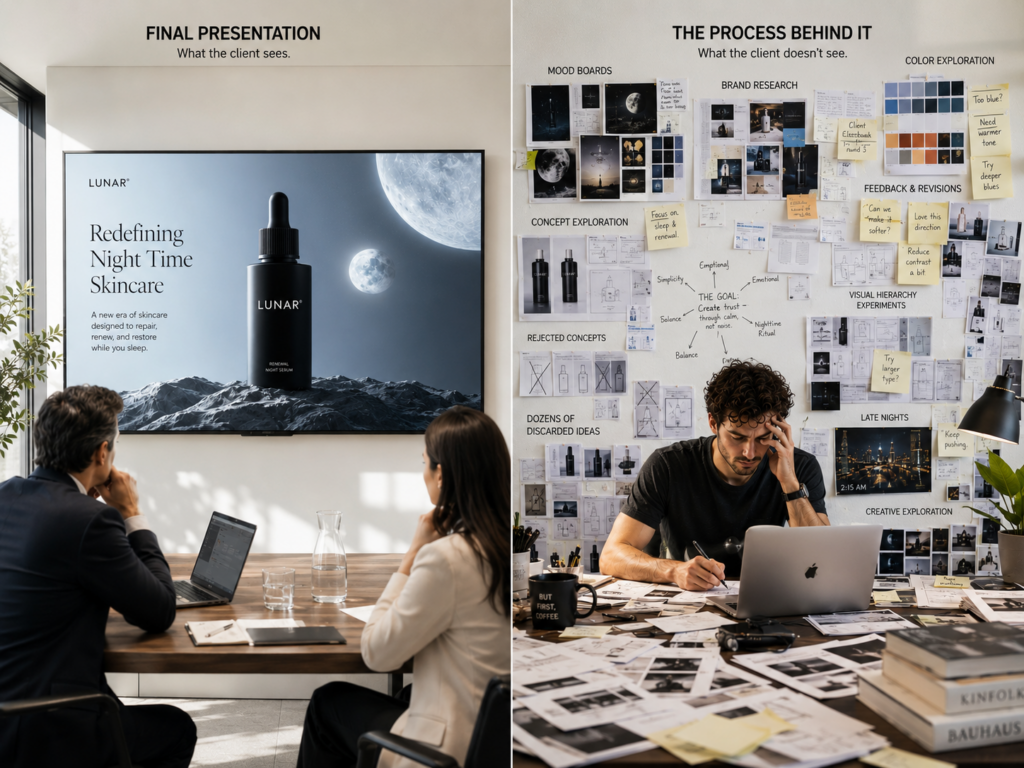
Beyond cognitive load, there’s another layer of exhaustion that creative professionals carry silently: emotional labour.
Think about what creative work actually requires of you, emotionally. You spend weeks internalising someone else’s vision, a client’s brand, a creative director’s aesthetic sensibility, a campaign’s strategic intent, and then express it through your own craft. You’re not making your art. You’re making their art, in your voice, to their standards, against their deadline.
That’s a particular kind of emotional labour that doesn’t exist in many other professions. Research in Organizational Psychology confirms that sustained emotional labour, the ongoing work of regulating how you express yourself in alignment with external expectations, directly contributes to exhaustion and disengagement over time. The study found that high emotional demands, when paired with insufficient support resources, are a significant driver of burnout.
There’s also the specific sting of creative rejection. When a piece of analytical work gets sent back for revisions, it’s a data problem. When a piece of creative work gets rejected, it can feel like a personal one. The work came from somewhere inside you. The brief became something you believed in. And then it was changed, diluted, or rejected by someone in a meeting who wasn’t in the room when it was made.
That costs something. Every time.
The Numbers Are Hard to Ignore
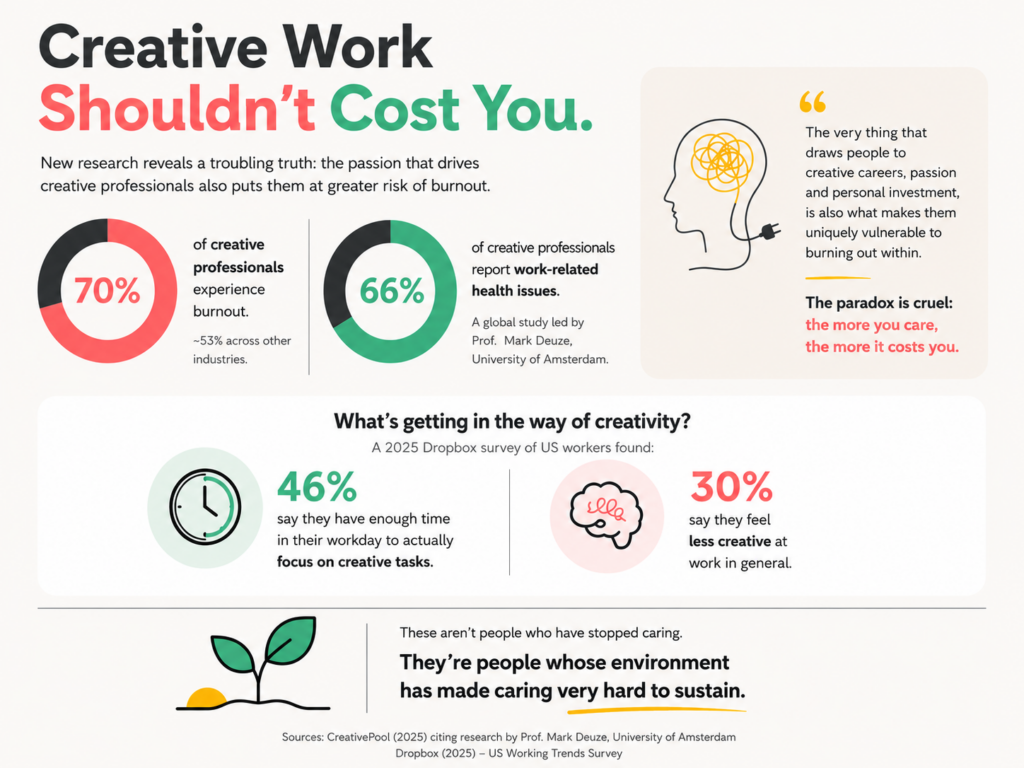
The short version: Creative professionals burn out at significantly higher rates than the general workforce, most don’t have enough time in their day for actual creative work, and the passion that draws people to these careers is the same thing that makes them most vulnerable to losing it.
The paradox is cruel: the more you care about the work, the more it costs you.
Two Kinds of Exhaustion, And Why Confusing Them Is Dangerous
Here’s the most important distinction this piece can offer, and it’s one that almost nobody makes clearly.
There are two kinds of creative exhaustion, and they feel similar but come from completely different places.
The first kind is craft exhaustion. It’s the tiredness that comes from doing something genuinely hard. Making real decisions under ambiguity. Caring deeply about output that you can’t fully control. Holding someone else’s vision in your head while expressing it through your hands. This exhaustion is unavoidable. It’s the cost of doing meaningful creative work, and in a strange way, it’s the good kind. A musician feels this after a great performance. A writer feels it after a paragraph that actually works. It’s evidence that you were fully present and that the work mattered.
The second kind is environmental exhaustion. It’s the tiredness that comes not from the craft itself but from the broken infrastructure around it. Chasing approvals across three different tools. Rebuilding your mental context after every interruption. Waiting days for feedback that arrives fragmented and contradictory. Doing revision loops that have no clear end state. Performing the administrative choreography that modern creative work demands before you can even begin the actual creative work.
Design Week’s 2025 analysis of the Dropbox creativity report noted a significant shift in how burnout presents in creative professionals today, less like physical fatigue and more like the gradual depletion of attention and curiosity. Chronic focus loss. Creative blocks. Irritability in collaboration. These aren’t signs that someone has run out of ideas. They’re signs that the environment has made it nearly impossible to find the space where ideas live.
Confusing these two kinds of exhaustion is where the real damage happens. Because when environmental exhaustion starts to feel like craft exhaustion, you start questioning whether you still love the work. You wonder if the passion has gone. You take a holiday and come back to find the dread is still there. And you begin to believe, wrongly, that the problem is you.
You Haven’t Lost Your Passion. You May Have Lost Your Environment.
The craft exhaustion: KEEP IT. It means you’re doing real work. It means the bar you hold yourself to is high and the work you produce reflects it.
But the environmental exhaustion, the unnecessary drag, the fragmented feedback, the context-switching tax, the administrative fog that wraps around every deliverable, that part is optional. It’s not the cost of doing great creative work. It’s the cost of a broken environment. And it deserves to be treated as the structural problem it is, not a personal failing to be pushed through.
When you design an environment where context lives inside the work, where feedback doesn’t require a three-app commute to find, where a completed task actually closes, you don’t eliminate exhaustion. You just return it to its right size. What’s left is the good kind: the productive, meaningful, identity-affirming tiredness of someone who made something real today.
That kind of tiredness, you can sleep off. The other kind just accumulates.
Your team’s best creative energy is a finite resource. ButtonShift is built to make sure none of it gets wasted on the wrong kind of exhaustion. See how a unified creative workspace protects your team’s focus and keeps them where they do their best work.
Here’s a question worth sitting with honestly: When you feel exhausted by your creative work, is it the work itself that’s draining you – or everything that surrounds it?