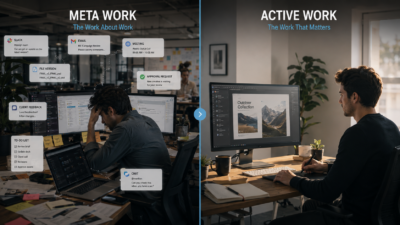
You did everything right. Phone on airplane mode. Laptop left at home. Four days, no Slack, no inbox, nothing. The kind of break people tell you to take.
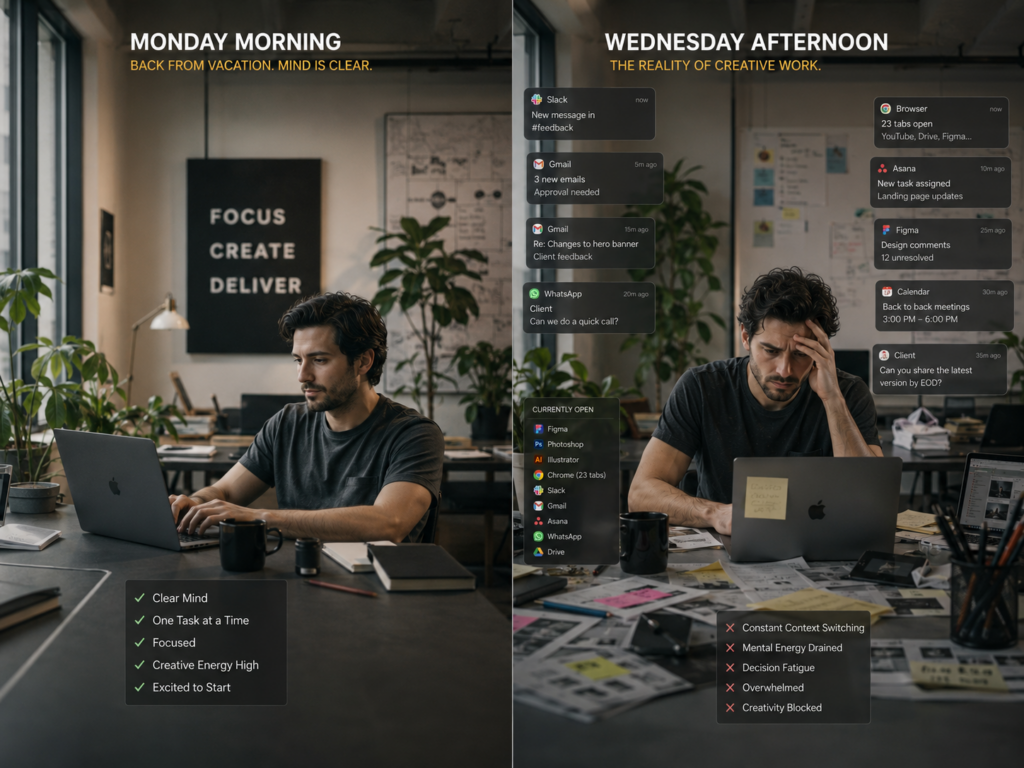
Monday morning, you actually feel it. Lighter. Clearer. For about three hours, you’re convinced it worked.
Then it’s Wednesday, 4 PM, and you’re staring at the same screen with the same fog behind your eyes that sent you looking for a break in the first place. Nothing has happened. No crisis, no late night, no extra hours. You just… drained again. Fast.
That shouldn’t be possible. Not if rest actually fixes whatever this is.
So here’s the uncomfortable question worth sitting with for a second: what if it never did?
You Cured the Wrong Thing
There are two different machines inside your head that both produce the exact same feeling and only one of them responds to sleep.
The first runs on depletion. You push hard on something demanding for hours, you use up a real resource, and you need to refill it. This is what sleep was built for. It’s why four honest days off genuinely worked, for those three hours on Monday.
The second runs on something else entirely: switching cost. Every time your attention gets yanked from one thing to another – a message, a tab, a “quick question” and pulled back, there’s a tax. Not because the work was hard. Because your brain had to tear down one context and rebuild another, dozens of times, all day, every day.
A 2025 academic framework on fatigue confirms something strange: these two completely different mechanisms feel identical from the inside. Same fog. Same flatness. Same urge to lie down. Which is exactly why almost nobody catches the difference including you, last Thursday, when you booked that break.
You rested on the first machine. The second one was never touched.
Why Wednesday Always Wins
Here’s the part that explains everything.
Depletion fatigue is a tank. Empty it, refill it, you’re good – that’s the whole mechanism, and it’s why the refill actually holds for a while.
Switching fatigue isn’t a tank at all. There’s nothing to refill. It’s a toll booth, and the moment you drive back onto that same road, you start paying again. Immediately.
A 2025 report citing the Aflac WorkForces survey found 72% of employees dealing with record-high stress, and for a huge chunk of them, the problem was never that they hadn’t rested enough. It’s that the moment they came back, the same fractured environment was sitting there waiting, completely unchanged.
That’s your Wednesday. Same five tools. Same fifteen tiny interruptions before lunch. Same hunting for a file, a comment, an approval buried somewhere you can’t quite remember. Clinical research on post-vacation burnout confirms it plainly: if the actual stressor never changes, the break can’t hold, no matter how good it was.
You didn’t fail to rest properly. You rested perfectly. The toll booth just reopened the second you drove through it again.
The Expensive Mistake Almost Everyone Makes

Here’s where it gets costly, because nobody’s doing anything wrong on purpose.
A founder watches their best designer running on fumes and does the kind thing, orders them to take Friday off, throws in a wellness stipend, and says “seriously, switch off this weekend.” Genuinely generous. Completely aimed at the wrong machine. The designer comes back Tuesday, same fog, and now there’s a quieter, more confusing layer on top: I rested. Why didn’t it work? What’s actually wrong with me?
That question is worse than the tiredness. People start adjusting things that were never broken, sleep schedules, morning routines, caffeine intake, chasing a fix for a tank that was never empty in the first place. None of it touches the toll booth. None of it ever will.
And the one thing that would actually work never even gets considered, because the problem was never named correctly to begin with.
What Actually Closes the Toll Booth
If the cost comes from switching, the fix has to hit switching directly. Not more rest. Fewer forced detours away from the task to go dig up something that should’ve been right there, and a cheaper cost on the detours that genuinely can’t be avoided.
Our piece on the 23-Minute Rule gets into exactly what one of those detours costs in recovery time, if you want the receipts. What matters here is simpler: that cost resets to zero the second you’re back in the same scattered environment. That’s the whole story of your Wednesday, in one sentence.
The fix looks environmental, not personal. Fewer tools pulling attention in five directions. Feedback and files that stay attached to the work instead of scattered across a search. Approvals that don’t require a hunt. None of this makes the actual work effortless — real work should cost something, and that part is fine. What it removes is the extra toll stacked on top by surroundings nobody designed for a human’s attention span.
You Were Never Broken. You Were Just Paying the Wrong Toll.
The vacation worked exactly as well as a vacation can work. That was never the problem.
What you actually have isn’t a depleted tank that needed more time to refill. It’s a structural pattern that switches back on the instant your environment does, which means the question was never “how much more rest do I need.” It was always: how many tolls am I paying today, and can I close a few of them.
ButtonShift was built to close those toll booths, reducing how often your team has to break focus to chase context, and what it costs them when they do. See how a unified workspace lowers the switching cost itself.
Frequently Asked Questions
Why do I still feel exhausted even after a good night’s sleep or a vacation?
Sleep and rest are effective for depletion-based fatigue, where sustained effort has genuinely used up a resource. If your exhaustion actually comes from constant context switching, rest only pauses that cost temporarily – it doesn’t change the fragmented environment generating it, so the fatigue returns almost immediately once you’re back inside it.
What’s the difference between exertion fatigue and switching fatigue?
Exertion fatigue comes from sustained, demanding effort on one task and is resolved by rest, much like a depleted battery is resolved by recharging. Switching fatigue comes from an entirely different mechanism – the cost of repeatedly tearing down and rebuilding attention between contexts, regardless of how demanding any single task is. Both produce a near-identical feeling, which is exactly why they’re so easily confused.
How long do the benefits of a vacation typically last?
Research generally places the fade-out period for vacation benefits somewhere between three days and four weeks, depending on the person and how genuinely disconnected the time off was. For people returning to a highly fragmented work environment, the fade tends to happen much faster, since the structural cause of the fatigue was never actually addressed.
If rest doesn’t fix switching fatigue, what does?
The fix has to target the mechanism directly – fewer forced interruptions to retrieve missing context, and a lower cost each time an interruption genuinely can’t be avoided. In practice, that usually means consolidating scattered tools, keeping feedback and files attached to the task itself, and removing the need to hunt across platforms for approvals or status.
Here’s a question worth sitting with: the next time that fog shows up a few days after a “restful” break, are you actually tired, or just back on the same road, paying the same toll?