
Pull up your agency’s P&L from last month.
Revenue looks reasonable. Utilisation looks decent. Your team worked hard, you saw it with your own eyes. But the net margin is sitting at something that makes you quietly uncomfortable. Four, maybe five percent below where you expected it to be.
You dig through the numbers. No single line item explains it. Nobody overspent on tools. Nobody sat idle. The work got delivered.
So where did the money go?
The honest answer is somewhere most founders never think to look: the gap between Slack and Asana.
The Gap Has a Name
Every creative agency today runs on at least two tools that are supposed to work together but fundamentally don’t.
Slack (Whatsapp, Teams, Gchat) is where the real work happens, where decisions get made, where clients drop references, where a creative director says “actually, let’s go warmer on the palette,” where an account manager types “client approved, go ahead.” It’s fast, informal, and the closest thing to how people actually think and communicate.
Asana, Jira, Monday, or whatever your team uses is where work is supposed to be recorded. Tasks, statuses, timelines, ownership. The system of record. The thing your billing, reporting, and project reviews are built on.
The problem? These two tools don’t talk to each other in any meaningful way. Slack doesn’t know what’s in Asana. Asana doesn’t know what was decided on Slack. And the gap between them, that unmapped territory where context lives and dies, is where your margin quietly haemorrhages every single month.
According to a 2026 workplace collaboration report, the average employee now interacts with 10 to 14 different software tools every day. The cognitive overhead of navigating this fragmented landscape doesn’t just waste time, it fundamentally shifts people’s primary activity from creating value to managing the tools that are supposed to help them create value.
Three Ways the Gap Eats Your Profit
1. The Undocumented Revision
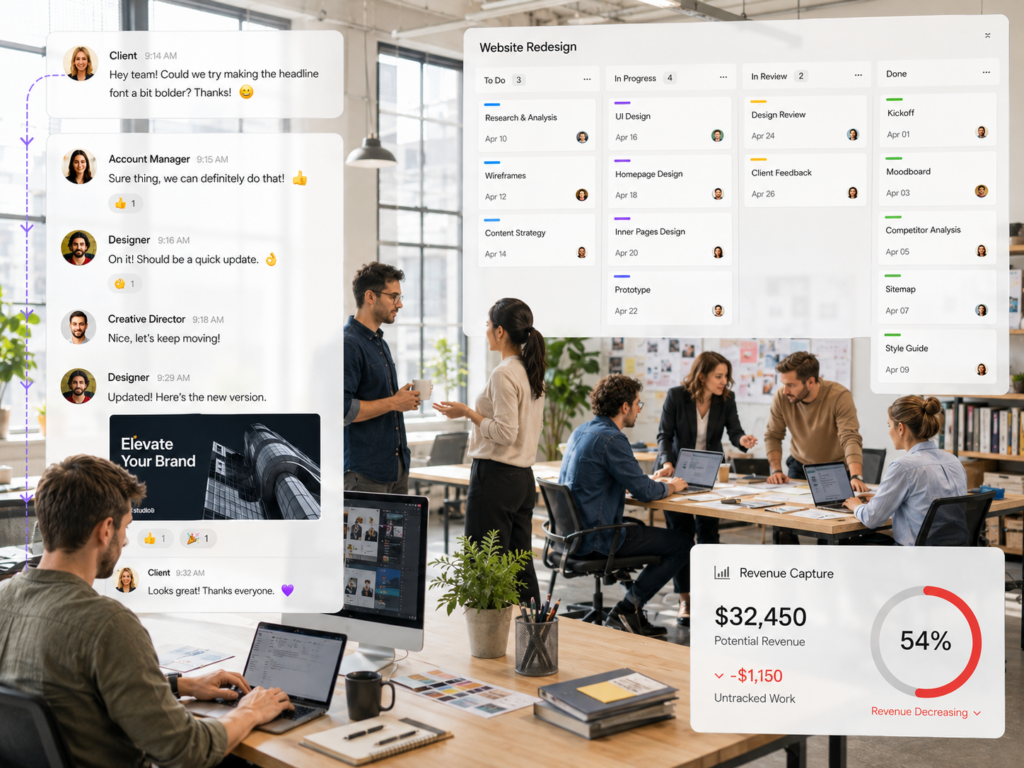
A client messages your account manager on Slack: “Can we just tweak the headline? Nothing major.”
The account manager passes it to the designer informally, another Slack message. The designer does it. The client is happy. Done.
Except it isn’t done. Because that revision was never logged in Asana. It was never raised as a change request. It was never flagged against the original scope. And because it was called “just a tweak,” nobody thought to bill for it.
This is not a rare scenario. The Ignition 2025 Agency Pricing and Cash Flow Report, based on a survey of 273 agency leaders across creative, digital, branding, and PR, found that 57% of agencies lose between $1,000 and $5,000 every month on unbilled work alone. A further 30% say scope creep costs them more than $5,000 a month. And the punchline? 78% of agencies say they rarely or only sometimes charge for out-of-scope work.
The revision wasn’t free. It just wasn’t captured.
2. The Ghost Task
This one is more insidious.
Sometimes an entire piece of work gets conceived, briefed, executed, and delivered entirely within Slack. A quick motion graphic for a client’s Instagram story. A revised tagline the creative director workshopped over a thread. A last-minute banner because the campaign went live a day early.
Real work. Real time. But because it was born and died in Slack, it never touched Asana. Invisible to reporting. Invisible to billing.
Industry research shows that 79% of agencies regularly over-service clients without additional compensation, and much of that over-servicing happens exactly this way. In the gaps. In the “while you’re at it” additions that never make it onto a timesheet. A mid-weight designer absorbing just five extra hours a week on out-of-scope work amounts to over 260 hours of productive capacity disappearing from your books annually.
A separate benchmark report from 2025 puts an even sharper point on it: 47% of agencies lose up to $500,000 a year on untracked hours alone, and those missing hours also distort future scoping, causing repeat under-pricing that compounds the loss across every subsequent project.
3. The Approval Loop
Here’s one that costs you not in output but in time, which amounts to the same thing.
A client gives approval on Slack: “Looks great, go ahead.” Your account manager sees it and moves on to the next fire. But the Asana ticket? Still sitting in “In Review.” Nobody updated it.
Three days later, your PM follows up with the designer. The designer says it’s done. The PM checks Asana, sees it’s still open, and messages the account manager. The account manager digs through Slack to find the approval, screenshots it, pastes it into the Asana ticket, and manually closes it.
That loop just consumed 40 minutes across three people to close a task that was already complete. Microsoft’s research across 31,000 workers found that the average employee already spends 57% of their workweek on communication tasks, meetings, emails, and chat, and only 43% actually creating. The approval loop is a perfect example of work that looks like coordination but is really just paying the price for disconnected tools.
Why More Process Won’t Fix This
The instinctive response from most agency founders when they notice this pattern is to create a new SOP. “All approvals must be logged in Asana.” “No revisions without a change request.” The team nods. A reminder bot gets configured.
And then, within two weeks, everyone is back to doing exactly what they were doing before.
Because the process fights against the natural way people work. Slack is fast. Asana is structured. When someone is under deadline pressure, they will always use the fast tool. RingCentral’s global survey of 2,000 knowledge workers found that more than two-thirds toggle between apps up to 10 times every hour, and nearly a third say each toggle causes them to lose their train of thought entirely.
You cannot enforce discipline into a broken environment. You can only change the environment itself.
The problem isn’t behaviour. It’s architecture.
What a Gapless Workflow Actually Looks Like
The fix isn’t a new rule. It’s a different kind of workspace, one where the gap between communication and task management hardly exists.
This is what context continuity looks like in practice – the discussion, the file, the feedback, and the task status all living in one thread of work, rather than scattered across two disconnected platforms that your team must manually bridge with screenshots, copy-pastes, and good memory.
Here’s the same scenario played out both ways:
Without context continuity: A client drops feedback on a brand film in a Slack thread. The designer reads it, makes the changes, and marks the Asana ticket as done. But the account manager, not tagged in Asana, doesn’t see the update. They follow up with the client separately. The client asks if the revision was incorporated. The account manager checks with the designer. The designer points to the Asana ticket. The account manager relays the update to the client. Three touchpoints. Zero new value created. Margin leaked.
With context continuity: The client’s feedback is pinned directly to the relevant task. The designer makes the change and marks it complete in the same view. The account manager sees the status update without being chased. The client gets a notification. One thread. Zero chasing. Nothing falls through.
The Margin Was There All Along
Your agency isn’t underpriced. Your team isn’t underperforming. The creative work you’re producing is almost certainly worth more than what you’re capturing on paper.
The leak is structural. It lives in the gap between where decisions are made and where work is recorded. And the only way to stop it is to close that gap, not with another SOP, but with a workspace that makes capture effortless and context impossible to lose.
Stop letting your margin fall through the cracks. See how ButtonShift connects your feedback, files, and tasks into one unified workspace – so nothing gets lost between the conversation and the deliverable.
Here’s a question worth sitting with: How much work did your team do last month that never made it onto an invoice, and do you actually know?