It’s 2 PM on a Wednesday. You have somewhere between 14 and 23 tabs open; you’ve honestly lost count.
You know which one you’re supposed to be working in. But you’ve ended up reading a comment thread in Tab 17, because Tab 9 reminded you of a reference you needed, which you opened from Tab 3, which you’d kept open since this morning because Tab 1 needed a file you still haven’t located.
You haven’t made a single creative decision in 40 minutes. And the worst part isn’t the lost time. It’s that low, persistent hum of anxiety sitting just beneath the surface of the afternoon, the feeling that you’re somehow always behind, always mid-task, always about to catch up but never quite there.
That feeling has a name. And it isn’t procrastination, laziness, or burnout. It’s what happens to a human brain that has been asked to hold too many open loops at once, for too long.
An Open Tab Is a Promise Your Brain Made to Itself
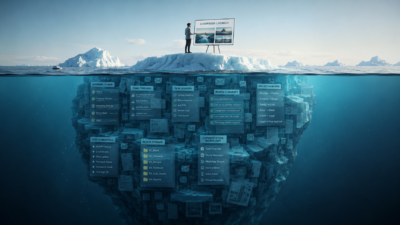
Here’s something most productivity advice misses entirely: every open tab isn’t just a tool. It’s an unresolved cognitive commitment.
When you open a tab and leave it open, your brain registers it as unfinished business. A task started but not completed. Psychologist Bluma Zeigarnik first documented this in the 1920s, the brain remembers incomplete tasks far more persistently than finished ones, holding them in active memory whether you’re consciously thinking about them or not. The Zeigarnik Effect, as it’s now known, means your brain experiences an open tab the way it experiences an interrupted conversation. It keeps returning to it. Keeps holding the thread.
Multiply that by 23 tabs and your brain isn’t managing a workspace. It’s managing 23 broken promises simultaneously, each one quietly competing for a share of your attention, generating a background hum of cognitive anxiety that has nothing to do with how hard or easy the actual work is.
A 2025 global study by Aloha Browser found that 71% of people start an online task only to drift away into other tabs and notifications, and 64% end their day feeling they didn’t accomplish something genuinely important. That’s not a focus problem. That’s the Zeigarnik Effect at industrial scale.
What Chronic Tab-Switching Does to You Over Time
The 23-minute recovery cost of a single context switch, documented in our earlier piece on the 23-Minute Rule, is the per-session toll. But what nobody talks about is what happens when that toll is paid, every day, for months.
The cumulative effect is significantly darker.
A 2025 paper published in Frontiers in Psychology confirmed that multitasking doesn’t just reduce productivity in the moment, it impairs the brain’s ability to retain information over the long term. Frequent task-switching depletes cognitive resources needed for problem-solving and focus maintenance, and the damage accumulates. You’re not just losing focus today. You’re quietly degrading your capacity to focus tomorrow.
Research from the Institute of Organisational Mindfulness, drawing on Frontiers in Human Neuroscience data from 2025, found that prolonged exposure to constant partial attention, the kind produced by chronic tab-switching, alters activation patterns in the prefrontal cortex and anterior cingulate gyrus; the brain regions responsible for executive control, decision-making, and self-regulation. In less than two minutes of unregulated task-switching, measurable lapses in sustained attention begin to appear. Over weeks and months, the architecture of focus itself starts to change.
A 2025 technostress research paper identifies this pattern as a key driver of what researchers call cognitive fatigue, not the tiredness of working hard, but the specific exhaustion of a brain operating in a state of constant fragmented attention, unable to fully engage with anything or fully release anything.
Knowledge workers now toggle between applications over 1,200 times per day, according to 2026 data from SpeakWise. Each toggle carries a recovery cost. The math isn’t sustainable, and the brain eventually stops pretending it is.
The Guilt Loop That Nobody Names
Here’s where the psychological toll gets genuinely cruel.
After weeks of living on the tab-switching treadmill, creative professionals don’t just feel tired. They feel guilty. They look at the half-finished layout, the script that’s been open since Tuesday, the storyboard that’s two frames longer than it was this morning, and they think, “What is wrong with me? I’m not working hard enough. I’ve lost my edge. Maybe I’m not cut out for this.”
This misattribution is the most damaging part of the whole pattern. Research on context switching consistently shows that chronic multitasking doubles anxiety levels, increases error rates by up to 50%, and reduces belief in personal growth capacity, a fundamental component of resilience. The person experiencing this doesn’t feel like someone operating in a broken environment. They feel like someone who is broken.
The loop compounds itself: the tab chaos makes deep work impossible → output falls below what you know you’re capable of → the gap between potential and production creates guilt → guilt generates additional cognitive load → which makes focus even harder → which produces even less output. Around and around.
Most creatives in this loop never question the environment. They question themselves. And the longer the loop runs unchallenged, the more it erodes not just output but professional identity, the sense of yourself as someone who is genuinely good at this.
The Difference Between Complexity You Chose and Complexity That Was Done to You
Not all tab-switching is equally damaging, and this distinction matters.
There is complexity you chose: deep research across multiple sources, parallel creative exploration, cross-referencing references to build a richer understanding of a brief. This kind of cognitive load, which is difficult, demanding, sometimes uncomfortable, is actually part of doing creative work well. It’s the complexity of craft.
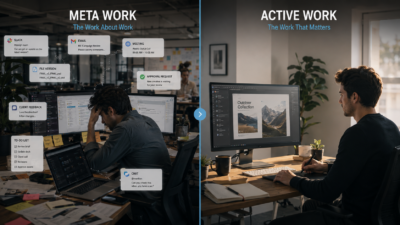
Then there is complexity imposed on you by a broken environment: chasing a file across three platforms because nobody documented where assets live, finding a client approval buried in a Slack thread from two weeks ago, reconstructing the context of a brief because the original is split across an email, a Google Doc, and a voice note that an account manager sent at 10 PM. According to McKinsey, the average knowledge worker spends nearly two hours every day simply searching for the information they need to do their work, not doing the work. Searching for the context to start it.
The psychological toll of imposed complexity is disproportionately higher than chosen complexity, because it carries an additional layer of helplessness. You didn’t choose this fragmentation. It was done to you by the tools around you, the workflows that were never designed for human concentration, and the environments where context lives everywhere except where the work actually happens.
That difference, chosen vs imposed, is the one that determines whether the day’s exhaustion feels earned or wasted. Craft exhaustion feels like something. Environmental exhaustion just feels like loss.
Your Brain Isn’t Broken. Your Browser Is.
The anxiety underneath the afternoon isn’t a character flaw. The guilt loop isn’t evidence of diminishing talent. The inability to finish things isn’t a discipline problem.
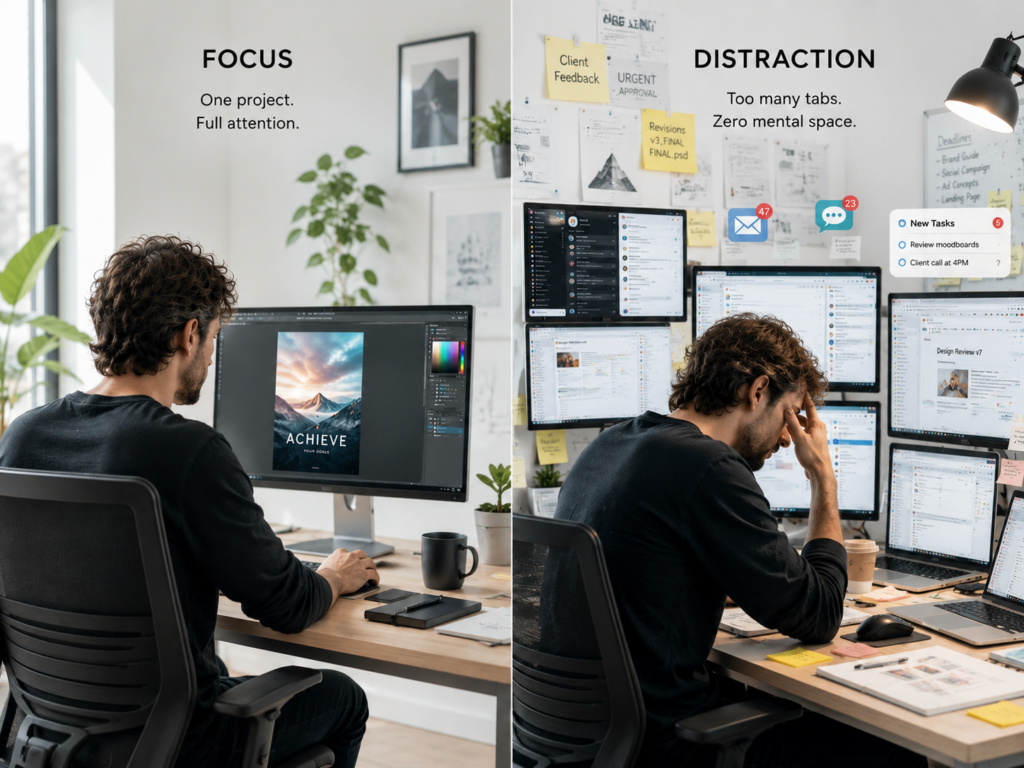
It is the predictable, documented, neurological output of a workspace that was never designed for sustained human concentration, a workspace where the context a creative professional needs to do their job is scattered across a browser that averages 11.4 open tabs per session, multiple communication platforms, shared drives, review tools, and project management systems that don’t speak to each other.
When the context lives inside the work; when feedback, files, approvals, and task status all exist in one place rather than scattered across 23 tabs, something shifts. Not just in output. In the felt experience of the workday. The background hum quiets. The broken promises resolve. The brain stops managing unfinished loops and starts actually finishing things.
That isn’t a productivity benefit. It’s a human one. And it’s the one that makes the work feel worth doing again.
The tabs aren’t your fault, but you don’t have to keep living in them. ButtonShift brings your files, feedback, and tasks into one unified workspace, so your team’s best thinking isn’t spent navigating the chaos around the work. See what a workflow with lesser tab-switch looks like.
Frequently Asked Questions
Why do open browser tabs make me feel anxious even when I’m not actively using them?
Each open tab represents an unfinished cognitive commitment, something psychologists call the Zeigarnik Effect. Your brain holds onto incomplete tasks far more persistently than completed ones, so a backlog of open tabs creates a constant, low-grade background hum of “unresolved business” that your mind keeps returning to, even when you’re consciously focused elsewhere.
How long does it actually take to refocus after switching tasks or tabs?
Research from UC Irvine puts the average recovery time at roughly 23 minutes after a single interruption. The cost isn’t the few seconds it takes to switch,but it’s the extended runway your brain needs to fully rebuild the mental context of the original task afterward.
Is constant context switching actually linked to anxiety, or is that an exaggeration?
It’s well documented, not an exaggeration. Studies show chronic multitasking can double anxiety levels and increase error rates by up to 50%, while also reducing a person’s belief in their own capacity to grow and improve a core component of psychological resilience.
What’s the difference between healthy multitasking and harmful context switching?
The difference lies in whether the complexity is chosen or imposed. Deep research across multiple sources or parallel creative exploration is complexity you actively choose, and it’s part of doing rich creative work. Chasing files across scattered tools, hunting for feedback buried in old chat threads, or reconstructing context that should have been documented in one place is complexity imposed on you by a broken environment, and it carries a much higher psychological cost because of the added helplessness involved.
Here’s an honest question to sit with: When you feel anxious at your desk without being able to explain why, how many of your open tabs have been open since yesterday?