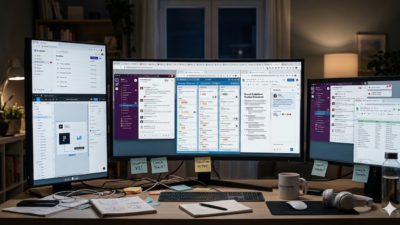
It starts with a soft vibration on your desk.
You are currently forty minutes into “the zone.” As a motion designer, you’ve finally mapped out the physics of a complex animation. As a writer, you’ve finally found the rhythm of a difficult paragraph. You are in a state of high-flow, the most valuable cognitive state a creative professional can occupy.
Then, the ping.
It’s a message from the Creative Director: “Quick one! Can you grab the final link for the Alpha-Tech project? The client is asking for it now.”
You tell yourself it’s a thirty-second task. You minimize your workspace, jump into Google Drive, find the link, and paste it back. On paper, you were “away” from your work for less than a minute.
In reality, you just set fire to your afternoon.
The Myth of the “Quick Switch”
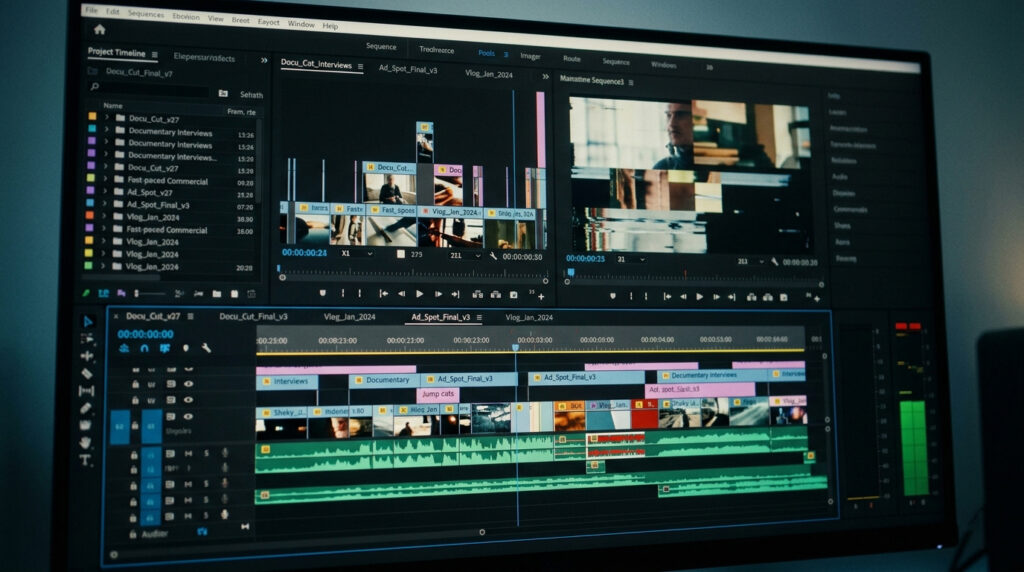
In the modern creative agency, we treat “just checking” as a harmless necessity. We’ve been conditioned to believe that we are efficient multitaskers. But cognitive science tells a different, much more expensive story.
This is the 23-Minute Rule.
Based on landmark research by Dr. Gloria Mark at the University of California, Irvine, it takes an average of 23 minutes and 15 seconds to return to your original level of deep focus after a single interruption.
That “quick link” wasn’t a 30-second favor. It was a 24-minute tax on your brain. If this happens four times a day, a conservative estimate in most agencies, you haven’t just lost two minutes of typing. You’ve lost nearly two hours of your most potent creative capacity.
The Cognitive Science: Why the “Tax” is So High
To understand why our brains don’t just “snap back” into work, we have to look at the biological mechanics of concentration. Focus isn’t a light switch, it’s a high-performance engine that requires a specific temperature to run.
1. Task-Set Reconfiguration
When you move from animating a 3D scene to searching for a URL, your brain undergoes Task-Set Reconfiguration. You have to deactivate the mental models, short-term memory caches, and “creative rules” required for design, and activate the “administrative rules” required for navigation and communication.
This transition is heavy. It’s like a massive industrial turbine slowing down to a halt before it can spin up in a different direction. You cannot simply “pivot” mid-spin without grinding the gears.
2. Attention Residue: The Ghost in the Machine
Coined by Dr. Sophie Leroy, Dean and Professor at University of Washington, Bothell School of Business, Attention Residue occurs when part of your cognitive resources stay “stuck” on the previous task.
While you are searching for that link, your brain is still partially processing the animation curves you just left. Conversely, when you return to the design, your brain is still wondering if the manager saw the link or if the client is happy. You are essentially trying to create with only 60% of your processor. You’re physically present in the “Primary Window,” but mentally, you’re still cleaning up the mess from the interruption.
3. The Metabolic Cost of Executive Function
Your prefrontal cortex, the part of the brain responsible for “Executive Function” (deciding what to focus on), is the most energy-hungry organ in the human body. Every “switch” burns through a measurable amount of glucose and oxygen.
This is why creative teams feel like they’ve been hit by a truck by 3:00 PM. They aren’t tired from creating; they are tired from the metabolic cost of constantly rebooting their mental operating systems.
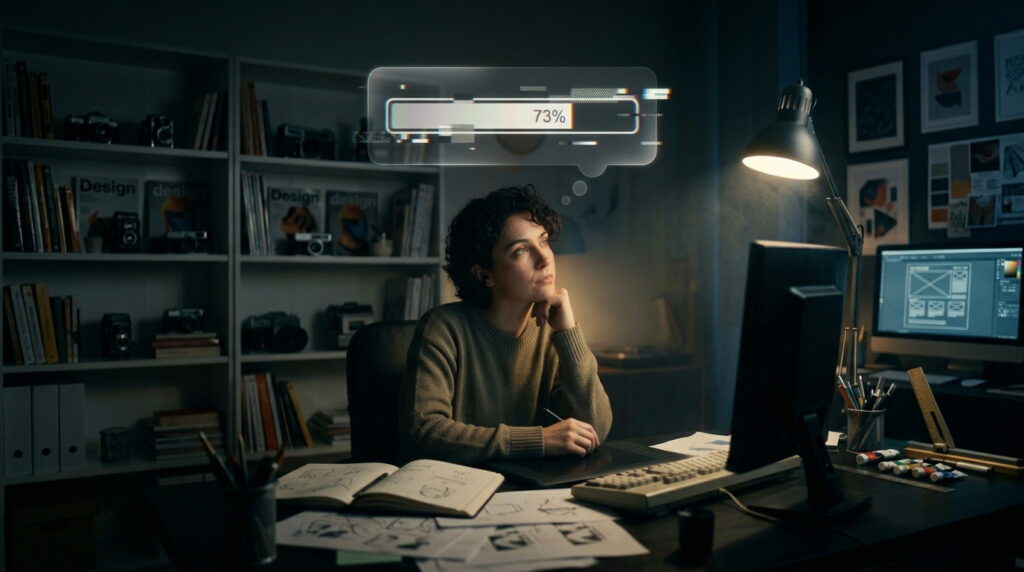
The Anatomy of the 23-Minute Leak: A Step-by-Step Autopsy
The “leak” isn’t about how long it takes to find a file; it’s about the cognitive detour that happens along the way.
- The Fracture (Minutes 1–2): The notification pings. Your focus breaks. Even if you don’t answer it immediately, the “Zeigarnik Effect” kicks in, a psychological phenomenon where the human brain remembers interrupted or incomplete tasks better than completed ones. You now have a mental “open loop” that won’t close until you check that message.
- The Decision Maze (Minutes 2–6): You enter the digital junk drawer (Google Drive or a messy server). The search for a filename gives six to seven outputs and you open a few files to decipher the right one. You also scan notifications under ‘Shared with me’ and start engaging. Your brain is forced into “high-frequency evaluation” mode: “Is this the right version? Did I reply to that? Is this folder supposed to be empty?” These micro-decisions act like a “mental drain,” emptying your battery before you even find the link.
- The Contextual Overlap (Minutes 6–15): You return to your primary window. Now, your brain has to purge the “Administrative Rule-Set” and reload the “Creative Rule-Set.” You sit there staring at the screen, trying to remember the “vibe” and the specific problem you were solving fifteen minutes ago.
- The Stabilization Phase (Minutes 15–23): You re-play your work. You re-read your last few notes. Finally, you feel that “click” where your neural pathways are fully aligned again.
What Does This Actually Lead To?
When we ignore this 23-minute recovery window, the impact isn’t just a loss of time. It manifests in a much more exhausting, human way.
For the Creative Specialist: The “Late-Night Catch-Up” Cycle
When you are interrupted every 20 minutes, you never reach the “Deep End” of thinking. This breeds a persistent, depressing sense of being less productive and efficient than you know you can be.
This is the root of Creative Fatigue. You find yourself working late into the night, not out of inspiration, but because the quiet of 9:00 PM is the only time you can finally bypass the 23-minute rule. You are sacrificing your work-life balance just to find the silence your brain needs to function. Over time, this erodes your love for the craft and leads straight to Burnout.
For the Founder: The Attrition Trap
From a leadership perspective, the 23-minute rule is a silent killer of culture. When your best talent feels like they are “running in place” or constantly wrestling with chaos, they lose their connection to the agency’s vision.
A team that is perpetually exhausted is a team that is looking for the exit. This leads to High Attrition and a significant impact on the bottom line, as the cost of hiring and training new talent far outweighs the cost of fixing a broken workflow. Ultimately, you aren’t just losing minutes; you are losing the institutional knowledge and the creative spark that makes your agency unique.
A Final Thought
Understanding the science of focus shifts the conversation from “productivity” to protection. For the Creative Specialist, guarding your focus isn’t anti-social, it’s a biological necessity to ensure your brain has the metabolic fuel to deliver its best work. For the Founder or Manager, every “quick ping” is a direct withdrawal from your team’s cognitive bank account. Ultimately, we must ask: are we cultivating an environment that respects the 23-minute recovery phase, or are we inadvertently engineering a culture of exhaustion?
We often ask our teams to “work harder” to meet deadlines. But perhaps the answer isn’t in more effort, but in less friction.